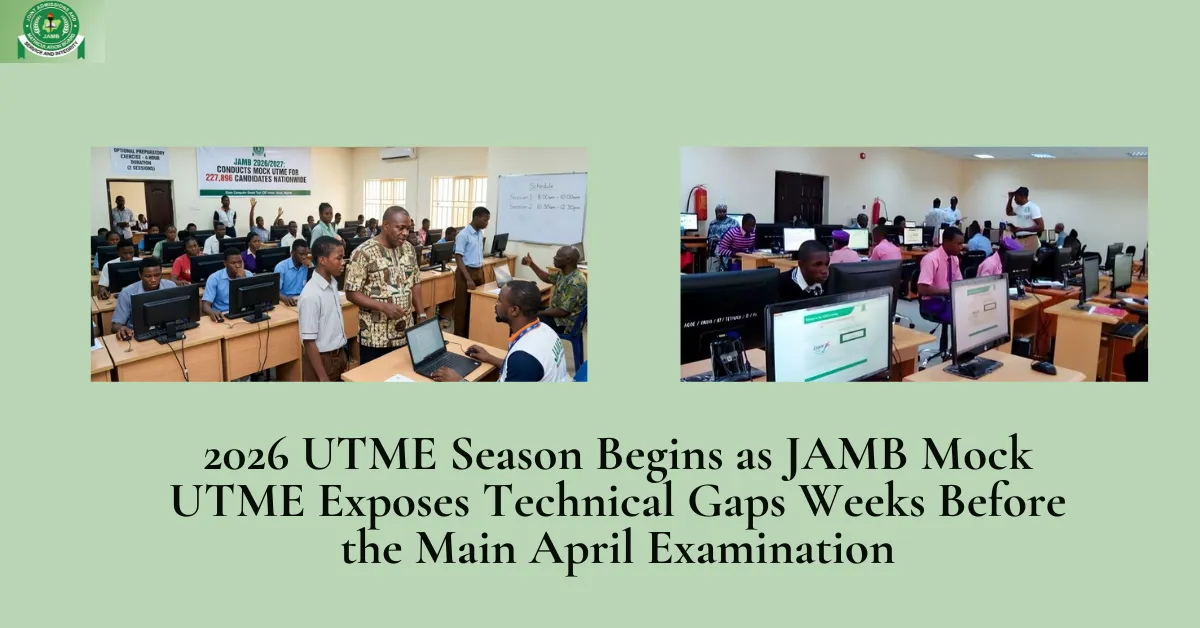
The Joint Admissions and Matriculation Board (JAMB) launched its 2026 examination season with the mock Unified Tertiary Matriculation Examination (UTME) on Saturday, drawing 227,896 registered candidates to Computer Based Test centres nationwide. But for many of those candidates, the day turned into a test of patience rather than preparation.
Reports from multiple locations described significant disruptions, including system failures, server downtime, biometric verification problems, poor internet connectivity and power outages. In several centres, computers shut down or froze mid session, forcing candidates to wait for extended periods with no clear resolution. "We got there before 7 a.m., but nothing started until almost noon," one parent said, capturing the frustration reported across numerous venues.
The scheduling of two sessions, from 8:00 a.m. to 10:00 a.m. and 10:30 a.m. to 12:30 p.m., compounded the problems at many centres, with overcrowding and poor coordination leaving students stranded for hours. Candidates were reportedly asked to arrive as early as 6:30 a.m., a requirement that drew criticism on X, where parents raised safety concerns about students travelling long distances in the early hours. Education expert Alex Onyia noted that a significant number of candidates were ultimately unable to sit the examination due to the widespread technical difficulties.
A few centres in Abuja reportedly ran without major incident, but the scale of complaints from other parts of the country has renewed questions about JAMB's operational readiness ahead of the main examination.
The Mock UTME, introduced by JAMB Registrar Professor Is haq Oloyede in 2017, is designed to familiarise candidates with the CBT format, reduce examination anxiety, and allow the board to stress test its systems. On Saturday, those systems came under exactly the kind of pressure the exercise is meant to anticipate, with results that will require a serious response from the board before the main UTME opens.
JAMB had warned ahead of the mock that candidates who registered but failed to attend would face consequences, describing slot allocation as a finite resource. Given Saturday's disruptions, the board may now face its own set of questions about whether the conditions it provided were adequate for the candidates who did show up.
The main UTME is scheduled to be held from 16 to 25 April 2026. For the hundreds of thousands of candidates who participated in Saturday's mock, the exercise offers a window into identifying gaps in preparation, getting comfortable with the testing interface, and approaching the actual examination with greater confidence.



Leave a Reply