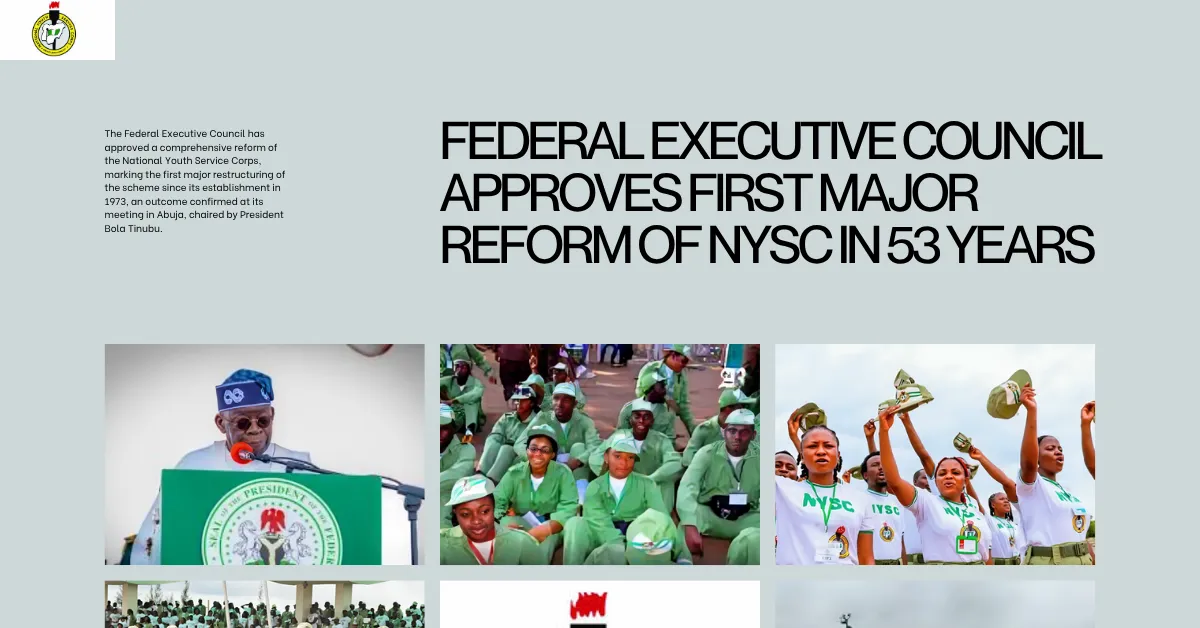
The Federal Executive Council has approved a comprehensive reform of the National Youth Service Corps, marking the first major restructuring of the scheme since its establishment in 1973, an outcome confirmed at its meeting in Abuja, chaired by President Bola Tinubu.
Minister of Youth Development, Ayodele Olawande, disclosed this while briefing State House correspondents after the meeting, noting that the reform followed a comprehensive review undertaken by the Federal Ministry of Youth Development in collaboration with the Federal Ministry of Education and the Office of the Special Adviser to the President.
A key component of the overhaul is the leadership structure of the scheme, with the National Youth Service Corps now to be headed by a civilian in its operational leadership, while the military continues to provide security support for corps members nationwide.
The Council has directed the Attorney General of the Federation and the Federal Ministry of Youth to amend the National Youth Service Corps Act and its regulations to give legal backing to the new framework and enable immediate implementation.
Special Adviser to the President on Policy Coordination, Hadiza Bala Usman, described the reform as holistic and unprecedented, explaining that it touches on virtually every strategic aspect of the scheme, including registration, deployment modalities, security considerations and the structure of the orientation camp.
"There was a need for us to intervene to build the present ambition of a $1 trillion economy by repositioning the NYSC as a civilian led, skill oriented, productivity driven, and youth empowering national institution," she stated.
According to her, the orientation programme has also been redesigned into a structured six week exercise, with corps members segmented across 11 distinct streams reflecting their academic backgrounds and skill profiles, including the agric corps, medical corps, education corps, tech and digital corps, legal corps and creative economy corps, among others.
Olawande further revealed that the reforms include full digitalisation of the scheme's operations, upgraded orientation camps meeting defined national standards, and a redesigned graduation ceremony to replace the traditional Passing Out Parade.
He noted that the scheme, founded after the Nigerian Civil War to promote national unity, would now be repositioned as a platform extending beyond mobilisation toward skills development, employment and national growth.


Leave a Reply