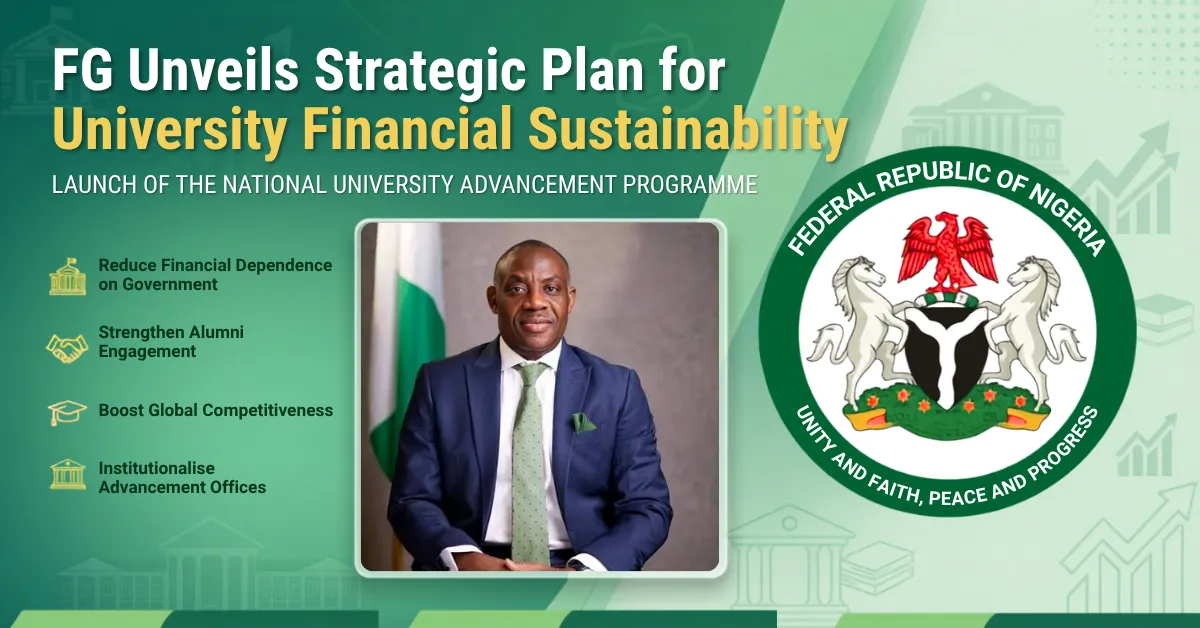
The Federal Government has unveiled a structured initiative to reduce Nigerian universities' dependence on government allocations and position them for global competitiveness, anchored on alumni engagement, donor partnerships and diversified institutional funding.
The Minister of Education, Dr Tunji Alausa, announced the details at the closing ceremony of the National University Advancement Programme training for university officials, describing the initiative as a strategic complement to existing government investment rather than a replacement for it.
"The National University Advancement Programme is not intended to replace government support for higher education. Rather, it complements existing investments by creating additional pathways for sustainability, innovation, research support, scholarships, and long term institutional growth," Alausa said.
The programme was established through a partnership involving the Federal Ministry of Education, the Nigeria Higher Education Foundation, and the Africa Finance Cooperation. It seeks to institutionalise professionally managed Advancement Offices across federal universities and inter university centres, with each office coordinating alumni relations, donor stewardship, endowment management, strategic communications, and institutional partnerships.
Alausa told participants that Nigerian universities hold one of “the greatest untapped assets in their alumni networks, many of whom continue to distinguish themselves across business, science, medicine, technology, entrepreneurship and public service, both within Nigeria and around the world."
He also elaborated on the returns that structured alumni engagement could generate. "When universities maintain strong relationships with their alumni, research receives greater support, students gain access to scholarships and mentorship opportunities, institutions build stronger partnerships, infrastructure improves, and innovation expands," the minister added.
Officials who attended the training were urged to return to their institutions and implement reforms that strengthen governance, promote accountability, and improve the student learning experience.
Alausa also reaffirmed that the education reform agenda under President Bola Tinubu's administration remained focused on expanding access to quality education and positioning the sector as a driver of national development.
Claire Jemide, Chairman of the Technical Working Committee of the Nigeria Higher Education Foundation, told the gathering that the University Advancement Programme, launched following a Memorandum of Agreement signed with the Federal Ministry of Education in January 2026, would equip universities with the knowledge, systems and strategies required for long term institutional advancement.
Wale Adeosun, Chairman of the Nigeria Higher Education Foundation, urged universities to treat alumni engagement as a sustainable revenue strategy, noting that strong endowment funds would provide institutions with the financial flexibility to invest in research, infrastructure and scholarships.



Leave a Reply