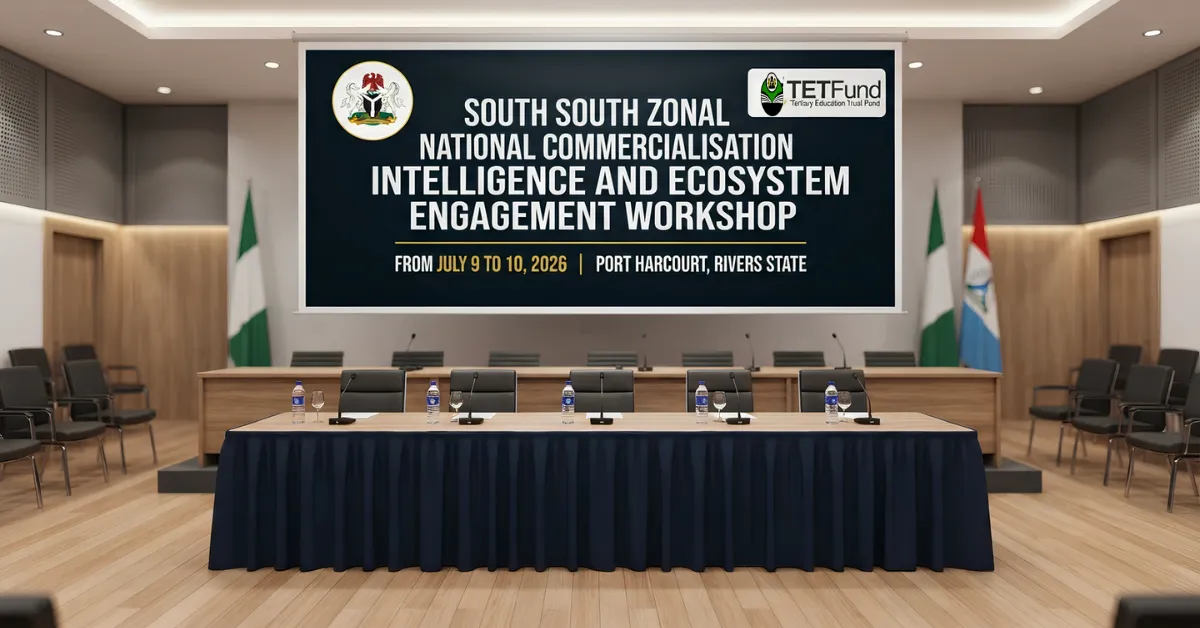
The Federal Ministry of Education, through its Research, Innovation and Commercialisation Committee in collaboration with the Tertiary Education Trust Fund, has concluded a zonal workshop in Port Harcourt aimed at accelerating the commercialisation of research across Nigerian tertiary institutions.
The South South engagement, which began on Thursday, is the first of six zonal workshops designed to strengthen the National Research and Commercialisation Intelligence Ecosystem.
RICC Chairman Tamunoibuomi Franklin Okujagu described the workshop as a critical step toward building a nationally coordinated innovation ecosystem capable of driving industrialisation, economic diversification and sustainable development.
"The proposed government owned intelligence platform will provide evidence based insights, support the commercialisation of research and indigenous innovations, and create sustainable economic value through intellectual property and home grown technologies," he stated.
Okujagu called on Nigeria to transition from a predominantly consumer economy to one that generates value through innovation and research, noting that the country's large population represents a ready market for locally developed products. Drawing on the experiences of Brazil, India, South Korea and Malaysia, he outlined RICC's priorities to include a National Commercialisation Intelligence System, digital public infrastructure for research commercialisation, stronger university and industry linkages, and a national commercialisation framework.
Keynote speaker Professor Seth Akutson, Vice President of Capital Markets Academics, said Nigeria must close the persistent gap between research output and industrial application.
"While Nigeria produces world class researchers, much of this knowledge remains within laboratories rather than being translated into commercially viable products," he said.
Akutson urged stronger collaboration between institutions and industry, improved intellectual property protection, innovation hubs, and demand driven research, citing South Korea, China, Israel, and Malaysia as models.
Stakeholders drawn from academia, industry, government, investors and innovation hubs examined regional innovation strengths, identified barriers to commercialisation and explored pathways for technology transfer and investment mobilisation. Participants committed to implementing recommendations that would feed into the National Research to Commercialisation Framework.
Leave a Reply