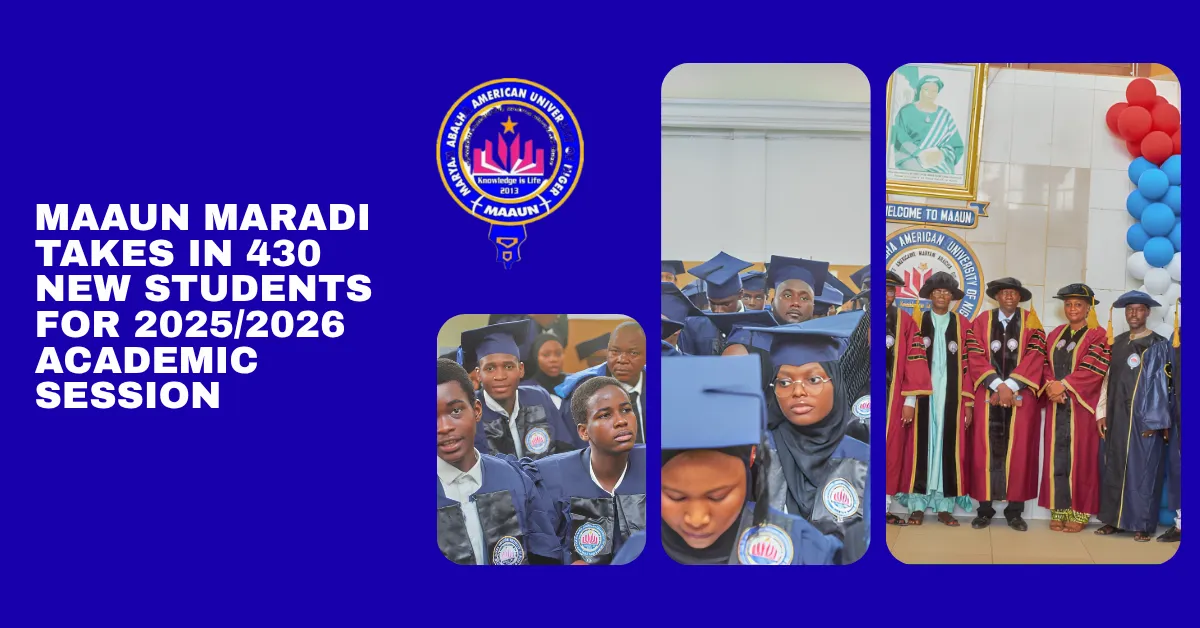
Maryam Abacha American University of Niger has matriculated 430 students into its undergraduate programmes for the 2025/2026 academic session, with the ceremony drawing attention to the institution's growing reputation as a bilingual higher education hub in West Africa.
The Director of the Maradi campus, Shuaibu Usman Tanko, told the new intake that matriculation represented more than a ceremonial milestone, describing it as a formal confirmation of their readiness for university life.
"Matriculation denotes the formal admission of candidates who are adjudged academically qualified, emotionally stable and ready to cope with the rigorous challenges of academic engagement," he stated.
Usman Tanko urged the students to remain focused and comply strictly with institutional rules, stressing that the university maintains zero tolerance for misconduct.
Founded in 2013, MAAUN is regarded as one of the first bilingual universities in Sub Saharan Africa, offering programmes in both English and French across science, humanities, research, and innovation. In January 2026, the AD Scientific Index ranked the institution as the number one university in the Niger Republic, placing it ahead of all public and private Institutions in the country.
Some of the newly matriculated students described the University as a platform for growth and international exposure, pointing to the track record of its graduates, particularly those in the health sciences. One student noted that alumni are working abroad, describing the institution as one that is "breaking barriers and paving the way for a more inclusive and diverse learning environment."
Officials disclosed that construction is ongoing at the permanent site in Djiratawa, Maradi, where a major campus development project is underway, reflecting continued investment in physical infrastructure and institutional capacity.
The university's affiliated institutions include MAAUN Kano, Franco British International University, and the Canadian University of Nigeria, extending its reach across the region.
The 2025/2026 matriculation reinforces the Institution's expanding role in higher education across West Africa as it continues to draw students from diverse backgrounds into its bilingual academic system.


Leave a Reply