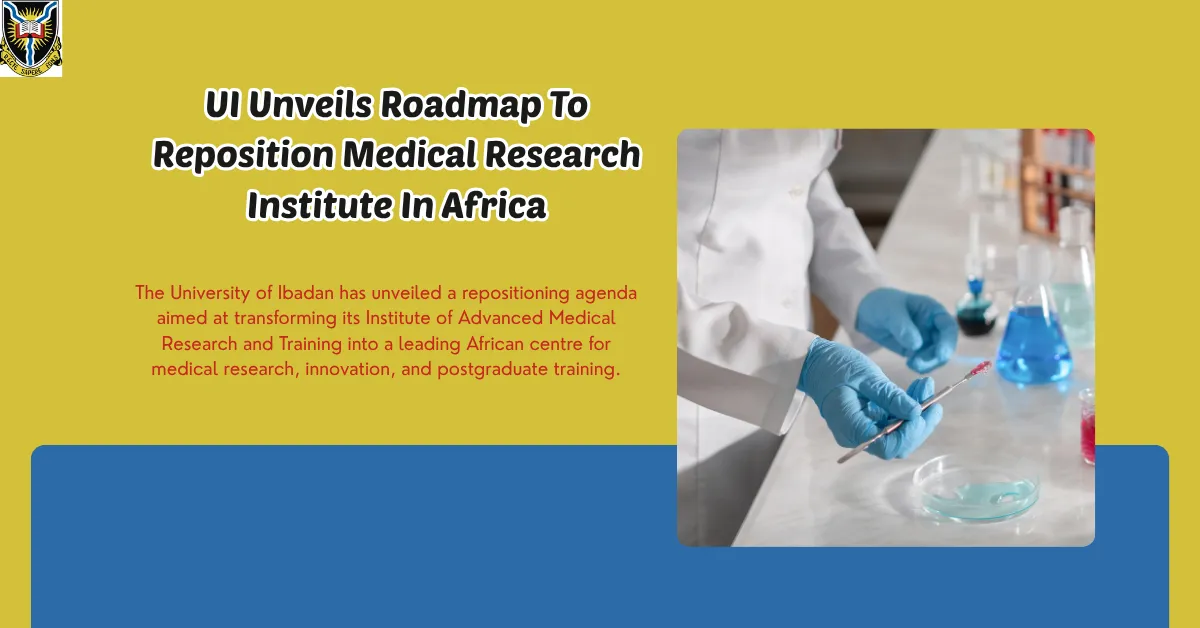
The University of Ibadan has unveiled a repositioning agenda aimed at transforming its Institute of Advanced Medical Research and Training into a leading African centre for medical research, innovation, and postgraduate training. The plan was presented during the opening of a two day organisational review and repositioning retreat themed Re Align, Re Energize, Re Position, held at the University's Digital Park in Ibadan, bringing together administrators, former provosts, research directors, medical researchers, policymakers, development partners, and alumni.
Director of the Institute, Professor Ike Ajayi, described the exercise as a defining moment in its history, noting that changing global research funding patterns, multidisciplinary collaboration standards and accountability requirements have made institutional reforms unavoidable. She disclosed that the Institute has recorded notable achievements in malaria research, infectious diseases, neuroscience, genetics, molecular medicine, epidemiology, environmental health, and public health, but stressed that sustaining that record now requires stronger governance, deeper collaborations, and increased funding. According to her, the retreat would review the Institute's 2021 to 2025 strategic plan, benchmark its operations against leading African research institutions and develop strategies for improving governance and resource mobilisation.
Provost of the College of Medicine, Professor Temidayo Ogundiran, argued that research institutions should subject themselves to the same scrutiny they apply in scientific investigations, maintaining that institutional strength should be measured not only by grants and publications but also by the ability to nurture young scientists and foster innovation.
Delivering the keynote address, former Director General of the Nigerian Institute of Medical Research, Professor Babatunde Salako, identified inadequate funding, limited infrastructure, a shortage of dedicated researchers and fragmented research efforts as major constraints. He proposed expanding the Institute's malaria programme into a broader infectious diseases hub covering tuberculosis, HIV, Lassa fever and emerging viral diseases, alongside stronger investment in cancer, genomics, cardiovascular diseases, diabetes and precision medicine, and recommended integrating overlapping research institutes under the Institute to reduce duplication.
Representing the Vice Chancellor, Deputy Vice Chancellor Professor Peter Olapegba reaffirmed the University's commitment to becoming a globally recognised research driven institution, noting that the Institute's contributions to malaria research and biomedical sciences had already strengthened its international standing, and that repositioning would enable it to lead scientific discovery from Africa rather than merely participate in it.


Leave a Reply