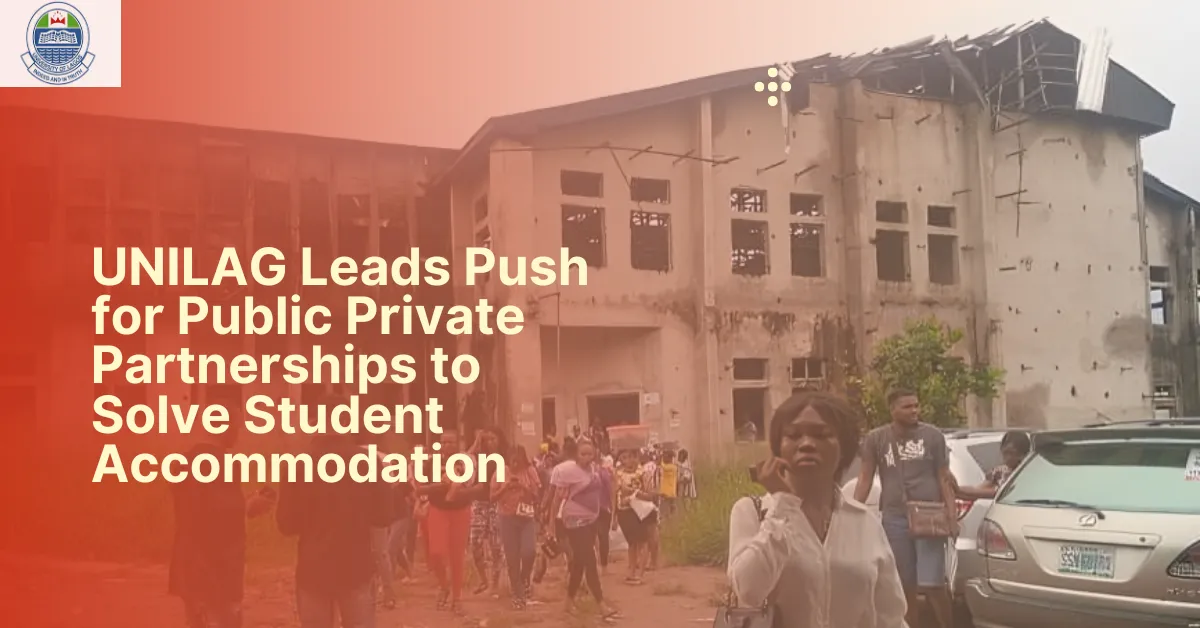
The University of Lagos is spearheading a new approach to address Nigeria's chronic student accommodation shortage, leading the way with a massive 7,836 bed hostel initiative built through Public and Private Partnerships that could serve as a blueprint for other tertiary institutions facing similar challenges.
The project, structured under a Build Operate Transfer model, brings together private developers, including CMF Gardens Housing Limited, Advent Integrated Services Limited, Paradigm Hostels Limited, and Diamantaire Limited, in what represents one of the most ambitious infrastructure interventions in Nigeria's higher education sector.
The initiative comes as Universities across Nigeria struggle to accommodate surging student populations. Thousands of students are currently forced into expensive and often unsafe off campus housing, paying exorbitant rents in a market that has shown little regard for their financial realities.
Imaenyin Usoro, a professional realtor with BRG Billionaires Realtors Group, praised the approach as a necessary departure from relying solely on government funding. "If we keep waiting for the government to provide enough facilities, it will be waiting till eternity. Tapping developers' funds will help universities deliver their projects in record time," he stated.
Other institutions, including the University of Ibadan, the University of Ilorin, the University of Abuja, and the University of Jos, have also begun exploring similar partnerships with the private sector to expand student housing.
Ike Chilaka Osuagwu, chief executive officer of Antwork Services Limited, noted that such collaborations mirror practices in developed countries. "In tertiary institutions overseas, captains of industry and organisations help develop infrastructures in the Universities," he said, describing the model as one that drives economic development while addressing critical student needs.
However, affordability remains a significant concern. Kunle Awobodu, a builder, pointed out that privately developed hostels are considerably more expensive than publicly funded ones, as developers aim to recover their investments quickly.
The cost gap is striking. Publicly built hostels at the University of Lagos cost around N80,000, Obafemi Awolowo University charges between N50,000 and N60,000, and the University of Ibadan sets fees at N60,000 per bed space. In contrast, the 484 bed space hostel built by Femi Gbajabiamila, the chief of staff to the president, at UNILAG costs over N700,000 per bed space.
Despite the price difference, Ibrahim Kudus, a UNILAG student, told BusinessDay that students are willing to pay higher fees because the facilities provide an ideal learning environment.
The model has proven successful in other African countries. Kenyatta University in Kenya partnered with Integras, a New York based private equity firm, to construct 10,000 bed space hostels worth $11 million. In Ghana, Kumasi Technical University partnered with GEOFRA Construction Works Limited to expand student housing, while the Université Privée de Marrakech in Morocco has leveraged private investment to upgrade facilities and research infrastructure.
As Nigeria's student population continues to grow and government funding remains constrained, the success or failure of UNILAG's PPP model could determine whether other universities follow suit or pursue alternative solutions to one of higher education's most persistent challenges.



Leave a Reply