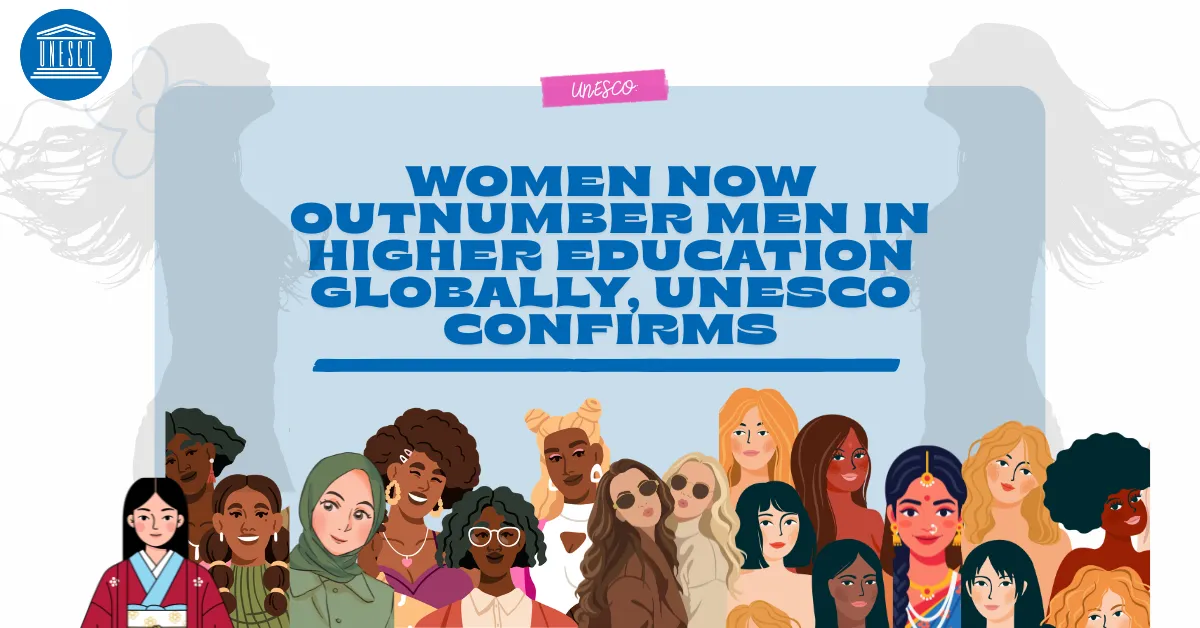
For every 100 men enrolled in higher education worldwide, there are now 114 women, according to a new UNESCO report that also warns of persistent gaps in access, completion, and leadership representation across regions.
The United Nations Educational, Scientific and Cultural Organisation disclosed this in its first report on global trends in higher education, released on Tuesday and covering data from 146 countries. The report confirms that gender parity has been achieved in all regions except sub Saharan Africa, with Central and South Asia recording notable progress, moving from 68 women enrolled for every 100 men in 2000 to full parity by 2023.
Despite the headline figure, UNESCO noted that women remain underrepresented at the doctoral level and hold only about a quarter of leadership positions in academia.
Global enrolment in higher education more than doubled over two decades, rising from 100 million in 2000 to 269 million in 2024. Regional disparities remain stark: 80% of young people in Western Europe and North America are enrolled in higher education, compared with 59% in Latin America and the Caribbean, 37% in the Arab States region, 30% in South and West Asia, and 9% in sub Saharan Africa.
UNESCO Director General Khaled El Enany acknowledged the expansion but cautioned against equating growth with equity. "This expansion does not always translate into equal opportunities, underscoring the need to develop innovative funding models to provide quality and inclusive higher education," he stated.
International student mobility also grew sharply, rising from 2.1 million students in 2000 to 7.3 million in 2023, though only 3% of the world's student population currently benefits from mobility opportunities. Seven countries, namely the United States, the United Kingdom, Australia, Germany, Canada, Russia, and France, host half of all international students globally, with Turkey and the United Arab Emirates emerging as increasingly popular destinations.
Private institutions account for about one third of the global student population, with Latin America and the Caribbean recording the highest share at 49% in 2023. Only one third of countries legally guarantee free public higher education, the report found.
The global gross graduation rate rose from 22% in 2013 to 27% in 2024, a pace UNESCO described as lagging behind enrolment growth. Refugee access to higher education improved from 1% in 2019 to 9% in 2025, though barriers around documentation and qualification recognition persist. UNESCO said it is addressing this through its Qualifications Passport initiative, currently active in Iraq, Kenya, Uganda, Zambia, and Zimbabwe.
Government investment in higher education averages 0.8% of global GDP, the report revealed, raising concerns about quality as systems expand. On technology, only one in five Universities had a formal artificial intelligence policy as of 2025, despite growing integration of digital tools into teaching and learning.



Leave a Reply