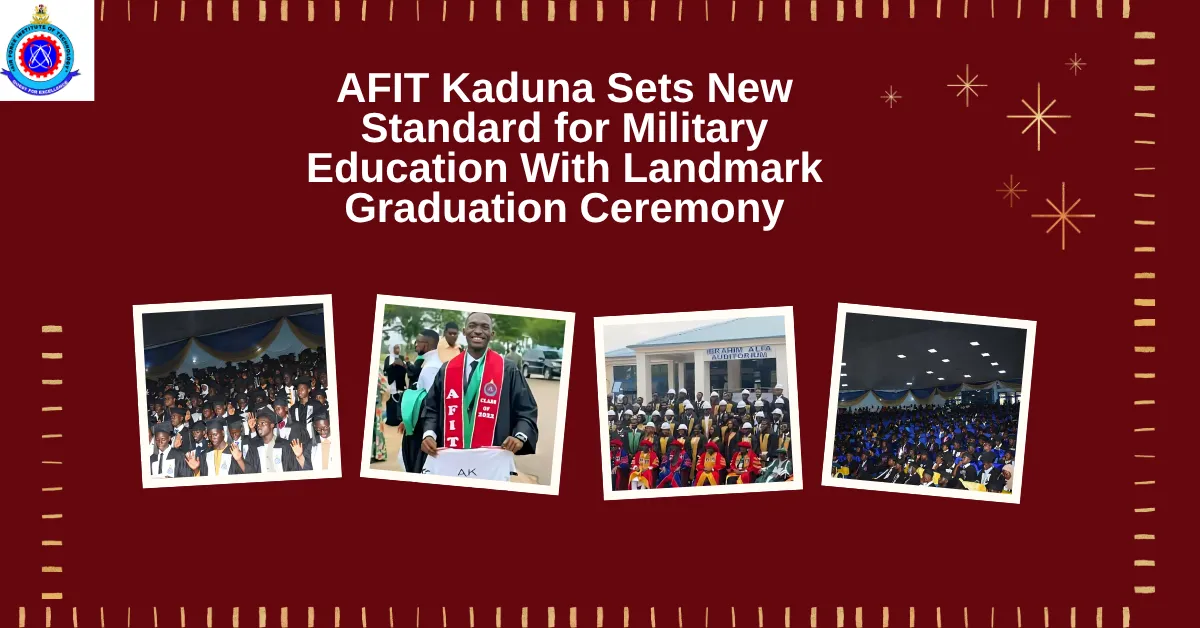
One of Nigeria's most specialised military Institutions has marked a significant milestone, graduating 3,000 students across its combined 2nd, 3rd and 4th Convocation ceremonies while announcing a sweeping expansion of its postgraduate academic offerings that signals its ambition to become a leading centre for advanced technology education in Africa.
The Air Force Institute of Technology in Kaduna will hold the ceremonies from 26 to 28 March 2026, with activities including COREN induction, exhibitions, project commissioning and convocation lectures. The Commandant, Air Vice Marshal Adeniran Ademuwagun, announced at a press conference ahead of the ceremonies.
A breakdown of the graduating class shows that 2,112 students completed programmes accredited by the National Universities Commission, 729 graduated under the National Board for Technical Education, and 159 completed programmes through the School of Postgraduate Studies. Of the total, 513 graduates specialised in Aerospace Engineering and Aircraft Engineering Technology, disciplines the Commandant described as critical to both the Nigerian Air Force and the nation's aviation industry.
Academic excellence was well represented across the graduating cohort. A total of 305 students graduated with first class honours, 146 obtained distinctions in NBTE programmes, and 51 recorded distinctions at postgraduate level. Three students distinguished themselves above all others, with Oluwole Winner Oluwatimilehin of Aerospace Engineering, Ahmed Amrah Abdulkadir of Cyber Security, and Babalola Jacobs David Oluwasegun of Physics each achieving a near perfect cumulative grade point average of 4.99.
The Institute also announced a dramatic expansion of its academic portfolio. Master's degree programmes have grown from two to 12, while postgraduate diploma programmes have increased from four to 12. Ademuwagun said the expansion is designed to position AFIT as a hub for advanced technology education and research in support of the operational and strategic needs of the Nigerian Air Force. Engineering graduates were also inducted into the Council for the Regulation of Engineering in Nigeria as part of the convocation activities.
For a country that continues to grapple with gaps in its technology and Aviation sectors, the graduation of 3,000 specialists from an Institution of AFIT's calibre, combined with a tenfold expansion of its postgraduate offerings, represents exactly the kind of investment in human capital that Nigeria's defence and industrial future depends upon.



Leave a Reply