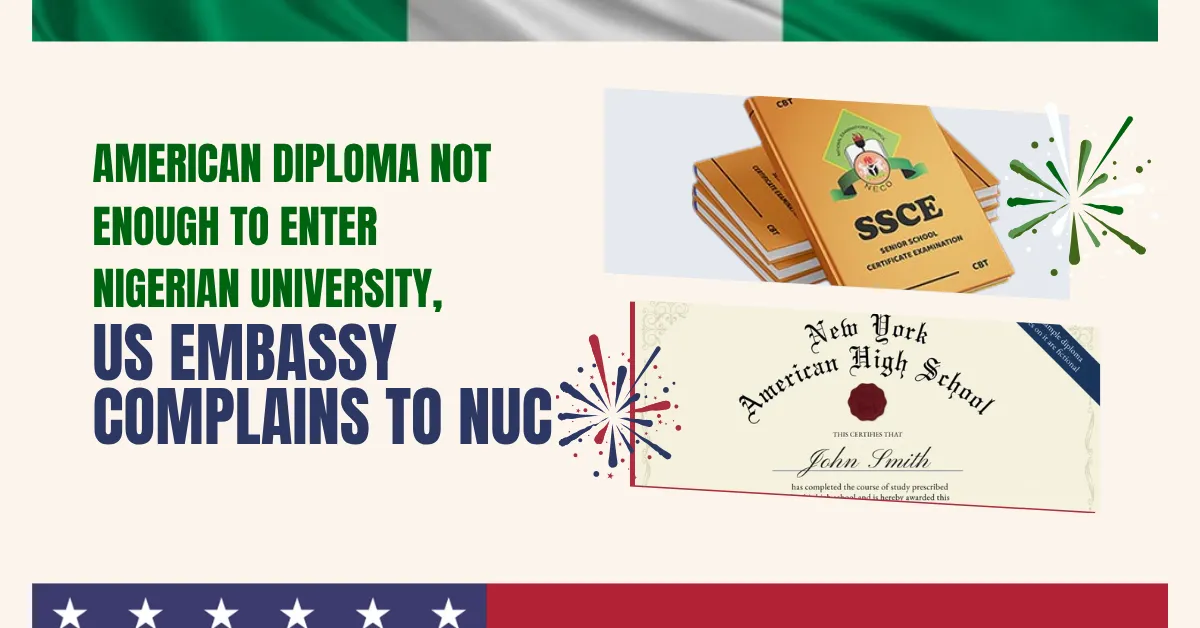
The United States Embassy in Nigeria has formally approached the National Universities Commission with a request to grant American High School Diplomas the same standing as the Senior School Certificate Examination within Nigeria's University admission framework, opening what could become a significant shift in how foreign qualifications are treated in the country's higher education system.
A delegation led by Cultural Attaché Ms Raisa Duncas and Education Specialist Ms Shade Adebayo visited NUC Executive Secretary Professor Abdullahi Yusufu Ribadu in Abuja, raising two key issues: the recognition of American High School Diplomas for University admission, and collaboration on artificial intelligence policy development across Nigerian universities.
Duncas expressed concern that Nigerian Institutions do not recognise the American High School Diploma, regardless of whether it was obtained locally or abroad, while Universities in the United States readily accept Nigerian credentials. She described the disparity as a gap requiring urgent attention, particularly for American trained students and expatriate children residing in Nigeria who are currently required to obtain additional qualifications from WAEC, NECO or NABTEB before sitting the Post UTME. She also noted that Nigerian students contribute over $800 million annually to the United States education sector, framing the issue as one of reciprocity between the two countries with deep educational ties.
Professor Ribadu acknowledged the concerns but was clear about the regulatory constraints. The American High School Diploma is not currently recognised within Nigeria's qualification framework, he explained, largely due to its nomenclature and its absence from the country's formal regulatory structure. Recognition of foreign qualifications, he noted, falls under the National Council on Education, the highest policy making body in the sector, chaired by the Minister of Education. Any qualification seeking recognition must first receive Council approval before agencies such as JAMB and the National Board for Technical Education can incorporate it into their frameworks.
Ribadu outlined two possible pathways. The first involves developing a comprehensive concept memo to facilitate the adoption of the American High School Diploma as a qualifying examination comparable to WAEC and NECO certificates. The second would position it as a higher level credential eligible for Direct Entry admission through JAMB, removing the need for additional examinations entirely. He cautioned, however, that either route would require extensive consultation with the Federal Ministry of Education and JAMB to determine an acceptable framework. He attributed part of the historical challenge to curriculum differences, noting that alignment has been easier with British institutions due to similarities in academic structure.
On artificial intelligence, Ribadu disclosed that the NUC has already partnered with DIMLAS Corporation, a United States based firm, to train Nigerian academics in the application of AI tools in Universities, and confirmed that a comprehensive AI policy for the Nigerian University system is at an advanced stage of finalisation. The US delegation expressed willingness to continue consultations with JAMB and the Federal Ministry of Education to build the broad based support needed for both initiatives to advance.
For the thousands of Nigerian families who have educated their children through the American schooling system only to find those qualifications unrecognised at home, the Abuja meeting represents a long overdue conversation, though whether it leads to policy change will depend on a regulatory process that has historically moved slowly.
Leave a Reply