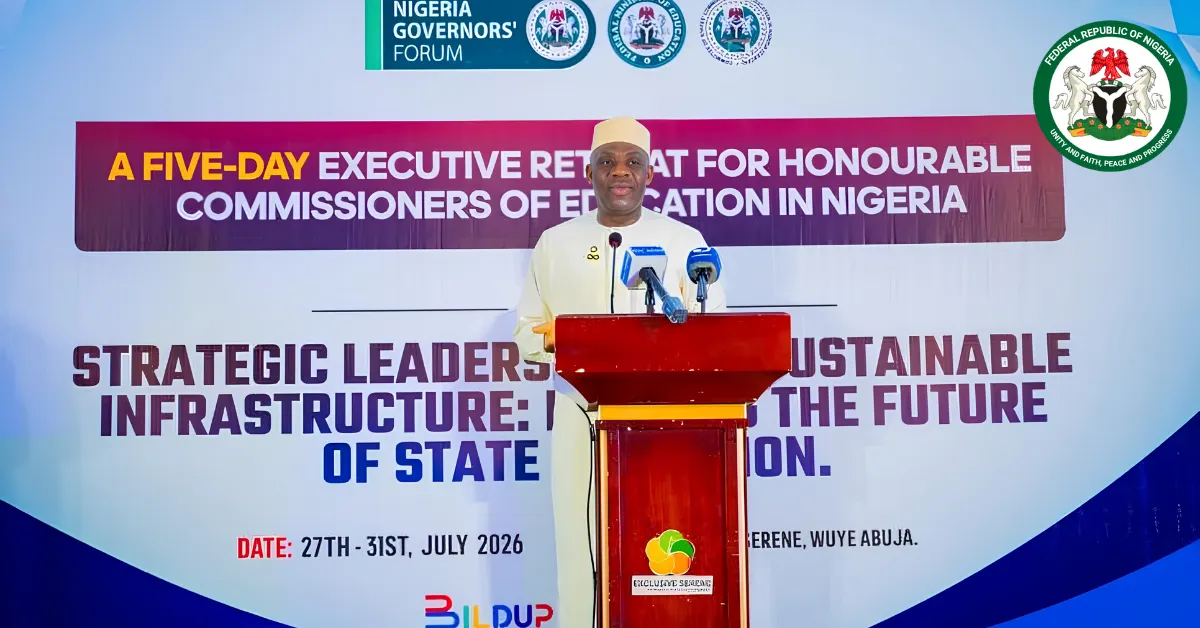
The Federal Ministry of Education has shifted from a directive relationship with state governments to a partnership model, with Minister Tunji Alausa urging commissioners to treat education spending as an economic and national security priority rather than a social obligation.
Alausa delivered the charge on Tuesday in Abuja at the five day executive retreat organised by the Committee of States Commissioners of Education in Nigeria, in collaboration with the Nigeria Governors Forum, state governments and the Ministry of Education. The retreat brought together 25 state commissioners alongside stakeholders from the World Bank and the Nigeria Governors Forum.
"Education is no longer simply a social service. Education is our strongest economic policy. It is our national security strategy. It is our industrial policy. It is our poverty reduction strategy. It is our innovation strategy. It is the foundation upon which the future prosperity of Nigeria will be built," he stated.
Alausa urged states to direct available resources towards instructional materials, school facilities and teacher recruitment, and to deploy school census data for more effective planning. He stressed that basic education remained the foundation for building the skilled workforce Nigeria required.
The minister announced the National Education Data Infrastructure as the centrepiece of the administration's education reform agenda, describing it as an integrated digital system designed to connect every tier of education governance. Under the framework, each learner would receive a unique identification number, every school a verified digital identity, and every teacher a digital profile.
He added that the Digitalised Nigeria Education Management Information System (DNEMIS) would complement the infrastructure by providing real time data on teacher pupil ratios, enrolment figures, infrastructure gaps and learning outcomes, enabling governments to respond to challenges with evidence rather than assumption.
The Former Aviation Minister, Osita Chidoka, delivering a paper at the retreat, urged commissioners to prioritise the quality of instruction over physical infrastructure, arguing that effective teaching produced more lasting outcomes than classroom construction.
"A good teacher can leave a lasting impact on a child's life, and many of us can still remember the teachers who taught and inspired us many years ago," he said.
World Bank Country Director, Mathew Verghis, urged state governments to meet the requirements of the HOPE Education Programme, noting that funding was contingent on achieving defined targets, including reductions in out of school children numbers and improvements in learning outcomes.
Leave a Reply