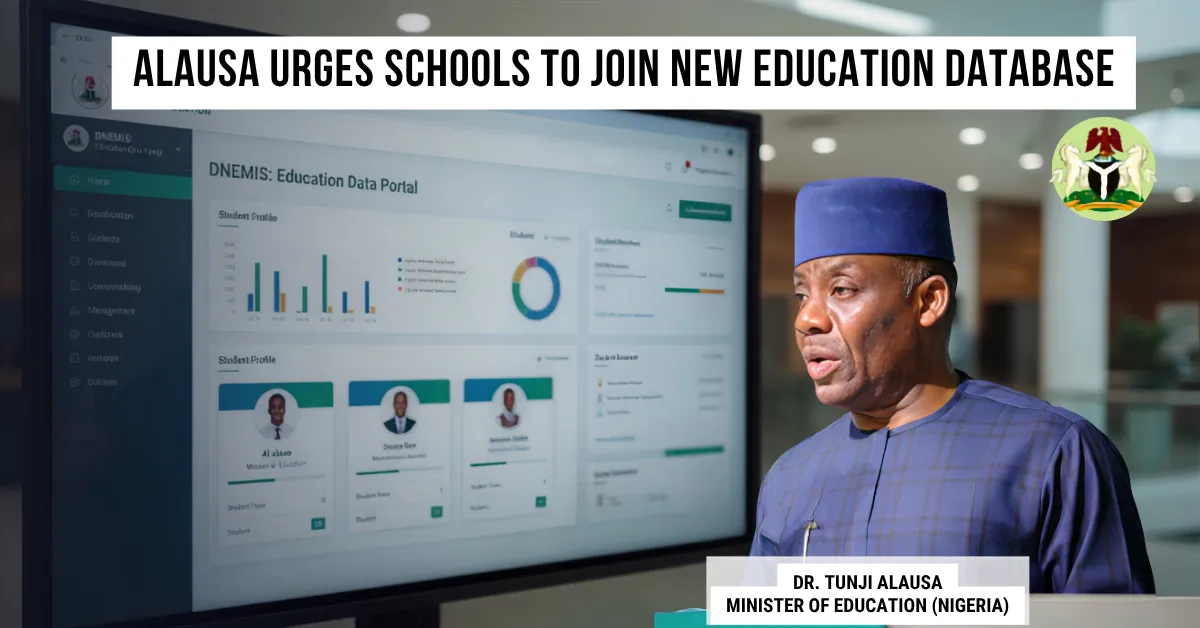
The Minister of Education, Dr Tunji Alausa, has called on state governments, local government education authorities, and private school proprietors to submit their data to the Digitalised Nigeria Education Management Information System (DNEMIS), warning that meaningful education reform is impossible without accurate and comprehensive records.
Alausa described reliable data as the backbone of every successful education reform and urged all stakeholders to treat participation as a responsibility rather than an option. "You have to get the data right. Data allows us to monitor, design interventions, evaluate outcomes, and plan proactively for the future. Without accurate data, meaningful development is impossible," he said.
Current figures show Nigeria has 213,235 schools, of which 124,548 have submitted data, representing a 58.4% reporting rate. The platform has so far captured 40,130,454 learners, 1,193,877 teachers, 730,447 classrooms, and 607,508 toilets.
Alausa noted that roughly 90% of public school data had been captured while private schools stood at approximately 50%, and urged private school owners to close that gap, assuring them that the exercise carried no taxation implications.
"Do not worry, the government is not collecting this information to tax you. We recognise the critical role private schools play in Nigeria's education sector," he said.
He pointed out that nearly three quarters of junior secondary schools are privately owned, making their inclusion essential for accurate national education statistics and effective resource allocation.
The minister said DNEMIS would enable governments at all levels to identify infrastructure gaps, deploy teachers efficiently, track enrolment and direct funding to communities with the greatest need. He commended the World Bank, the European Union, the Norwegian Government and UNICEF for supporting the platform's development after implementation delays threatened to stall the rollout.
The drive for complete data is set against troubling national indicators. UNICEF estimates Nigeria has approximately 18.3 million out of school children, while the World Bank reports that about 70% of Nigerian children cannot read and understand a simple age appropriate text by age 10.
National Bureau of Statistics Director General Semiu Adeniran pledged to integrate the NBS platform with DNEMIS to establish a single authoritative source of education data nationwide.
"The data that comes from our Small Area Estimation will help validate and cross check what is on the education platform," he said

Leave a Reply