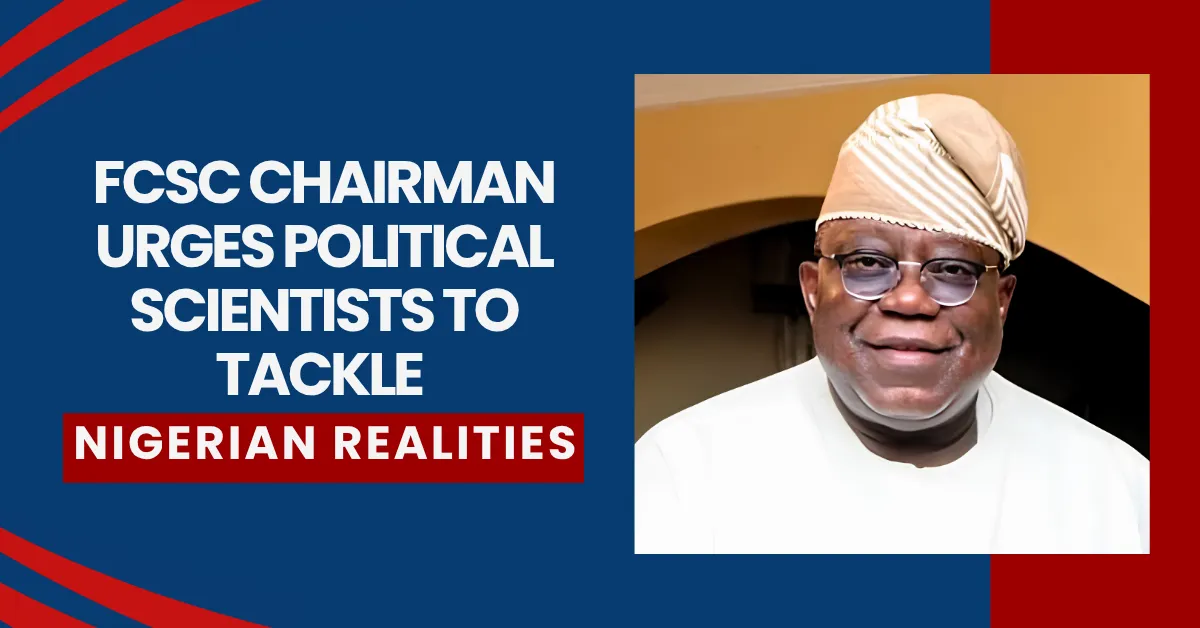
The Federal Civil Service Commission Chairman, Prof. Tunji Olaopa, has warned that political science risks deepening irrelevance unless scholars urgently bridge the gap between academic theory and the lived realities of ordinary Nigerians.
Olaopa delivered the charge on Wednesday as chairman of the opening ceremony of the 35th Conference of the Nigerian Political Science Association held at the University of Ibadan. The conference theme was "26 Years of Democracy in Nigeria: Reflections on Praxis and Challenges."
He argued that the discipline had grown increasingly detached from the struggles of millions of Nigerians contending with poverty, insecurity and unemployment, noting that growing methodological sophistication had paradoxically widened the gap between scholarship and public relevance.
"Like many scholarly disciplines in the contemporary world today, the fear expressed by well meaning critics that political science is mired in silo mentality and ivory tower isolation is real and incontestable. This is compounded by an increasing hyper specialisation that makes political science increasingly alienated from the idea of politics and the political as they affect millions of ordinary Nigerians who are struggling with insecurity, poverty, looming starvation, unemployment and myriads of existential challenges," he stated.
Olaopa called for a rebranding of the discipline to make its scholarship more public facing and accessible to politicians, policymakers and civil society. He stressed that such engagement must go beyond conventional town and gown arrangements to enable the co production of political and policy knowledge with grassroots movements, NGOs and other non state actors.
On curriculum reform, he highlighted the challenge posed by artificial intelligence, noting that political science pedagogy must now equip graduates to transition from theoretical instruction to work integrated learning through internships, scenario based teaching and multidisciplinary case studies.
"Such synergy enables the political science community to engage in collaborations with civil society organisations, grassroots movements, NGOs and other non state actors in designing research frameworks and curricula contents for a shared understanding of the status and direction that give the discipline relevance and legitimacy," he said.
He also raised questions about the ideological foundations of Nigerian democracy as the country approaches the 2027 general elections, urging political scientists to form a community of thinkers committed to defining what kind of political community Nigeria ought to be.
"These are the critical challenges that NPSA will have to mediate as a critical gatekeeper in the long drive towards making the discipline more relevant, more accessible for understanding and mediating the postcolonial predicaments of the Nigerian state," he added.

Leave a Reply