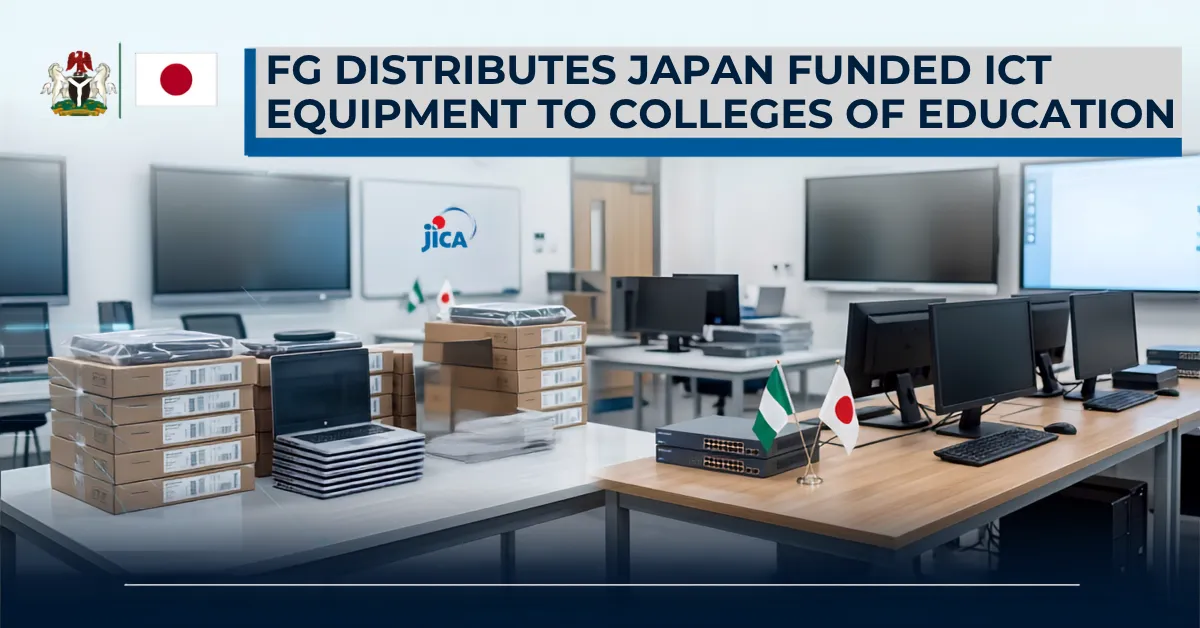
The Federal Government has begun distributing Information and Communication Technology equipment and instructional materials to 15 Colleges of Education across Nigeria in a move aimed at strengthening teacher training and improving digital learning.
The handover ceremony held in Abuja brought together the Minister of State for Education, Professor Suwaiba Sa’id Ahmad, officials of UNESCO IICBA, the National Commission for Colleges of Education, and representatives of the Embassy of Japan. The project is being carried out with support from the Government of Japan, UNESCO IICBA, and the African Union as part of a regional initiative involving six African countries.
Professor Ahmad said the intervention aligns with the Renewed Hope Agenda and national priorities in Technical and Vocational Education and Training, Science, Technology, Engineering and Mathematics, digitalisation, and efforts to reduce the number of out of school children. She stressed that teachers remain central to education reform and described the project as one designed to support digital teaching, inclusive learning, and safer schools.
The equipment handed over includes laptops, tablets, desktop computers, smart boards, projectors, printers, backup hard drives, and other data storage systems. The initiative also includes capacity building programmes to help educators integrate ICT into teaching practice and strengthen inclusive pedagogy.
Officials from UNESCO IICBA, the NCCE, and the Embassy of Japan commended Nigeria’s progress in teacher education and restated their support for teacher development, girls’ education, and safe learning environments. They also urged beneficiary institutions to use the resources effectively to improve teaching quality and learning outcomes.
The Ministry of Education called on the colleges to ensure proper use of the donated materials so that the impact on teacher preparation and educational quality can be sustained. The project is expected to improve digital literacy, expand access to learning materials, and support more effective classroom instruction in the beneficiary institutions.



Leave a Reply