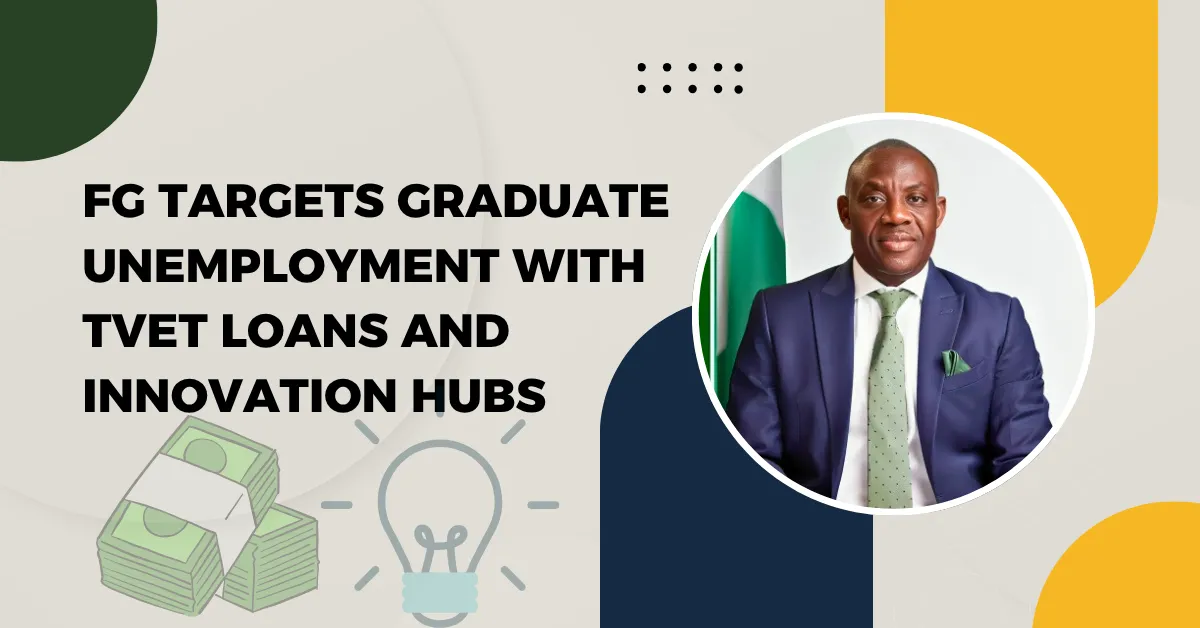
The Federal Government has disbursed ₦30 billion directly to students nationwide under the Technical and Vocational Education and Training (TVET) initiative, as the Minister of Education, Tunji Alausa, outlined a broad range of reforms aimed at reshaping learning outcomes across Nigeria's tertiary institutions.
Alausa disclosed this at the Renewed Hope Conversations held at the University of Abuja, where he addressed students on ongoing interventions in the education sector. He noted that the government is embedding entrepreneurship training into academic programmes, with innovation hubs, incubation schemes and venture capital grants of up to ₦50 million now available to support student led businesses.
"We are not training you to be job seekers. We are training you to be entrepreneurs, micro, mid level, and large scale," the minister told students at the event.
On student loans, he reiterated that beneficiaries of the Nigerian Education Loan Fund (NELFUND) would only begin repayment after securing gainful employment, describing the arrangement as a safeguard for students who might otherwise be unable to access higher education.
"We have introduced a student loan scheme to ensure that no willing student is denied access to education due to financial constraints. Repayment only begins after securing a decent job," Alausa stated.
The minister also highlighted the integration of artificial intelligence and data science into the national curriculum, from primary school through to university level, as part of efforts to align Nigerian education with global standards.
"The world is changing rapidly, and Nigeria must not be left behind. Skills development is central to our strategy," he noted.
Alausa added that 160,000 students have completed training under government backed vocational programmes, with a recent call for 100,000 additional slots drawing 800,000 applicants within days. Beneficiaries receive hands on training alongside starter packs to establish small businesses in areas such as fashion, solar installation and other technical trades.
The minister also pointed to infrastructure upgrades across campuses, including the deployment of mini grid power systems providing round the clock electricity and free internet access, as well as a 90,000 kilometre fibre optic rollout prioritising school connectivity nationwide.
"We are building an education system that prepares you not just for today, but for the future. The goal is to produce job creators, not job seekers," Alausa said.


Leave a Reply