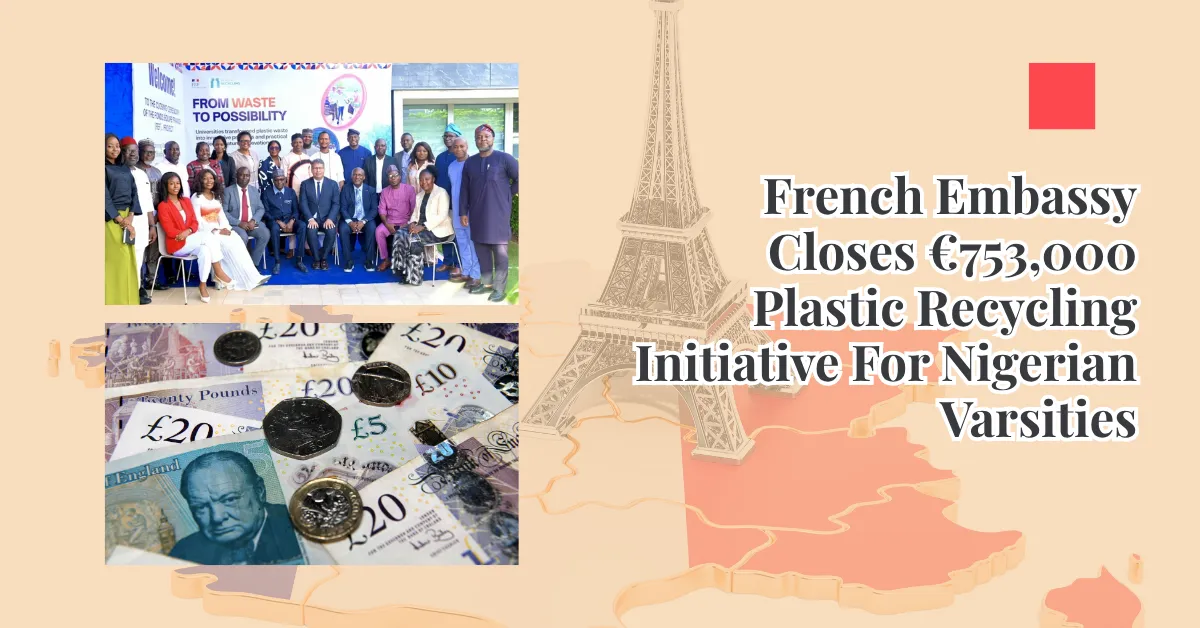
The Embassy of France in Nigeria has formally closed a three year, €753,000 Plastic Waste Processing Project that supported recycling, innovation, and entrepreneurship across Nigerian universities, with stakeholders describing the initiative as a significant boost to the country's shift toward a circular economy. Implemented under the Embassy's Fonds Équipe France framework, the project centred on improving plastic waste management through research, innovation, practical training, and the establishment of recycling micro plants on participating campuses.
At the closeout ceremony in Abuja, French Ambassador to Nigeria, Marc Fonbaustier, remarked that the project had shown that environmental sustainability and economic growth could advance together. "Environmental ambition and economic opportunity are not in opposition. They are, in fact, two sides of the same coin," he stated, adding that tackling plastic waste requires viable business models around collection, recycling, and reuse rather than regulation and awareness campaigns alone. He called for deeper collaboration between Nigerian and French universities, researchers, and private sector organisations, and confirmed France would continue supporting Nigeria through institutional partnerships and technical cooperation rather than direct project funding going forward.
Deputy Head of Cooperation at the Embassy, Pierre Andriamampianina, described the initiative as an outstanding success that delivered returns beyond its financial value. "The return on investment for Nigeria is much more than money. It is also in terms of capacity building, participation, and youth mobilisation," he noted, revealing that participating institutions had exceeded the project's original scope.
Vice Chancellor of the University of Lagos, Professor Folasade Ogunsola, represented by Deputy Vice Chancellor Professor Afolabi Lesi, disclosed that the university's micro plant would begin by producing household and office furniture from recycled plastics before scaling into commercial output, while also engaging waste pickers to secure steady raw material supply. She revealed the university currently diverts around five tonnes of plastic waste from landfills through the facility.
Vice Chancellor of the University of Calabar, Professor Offiong Efanga Offiong, represented by Professor Anthony Eneji, projected that participating universities could collectively generate more than ₦900 million from recycling activities. Project initiator Sebastian Bede, joining virtually, disclosed that the intervention had supported 13 universities, reached more than 1,700 participants across 11 campuses through awareness campaigns, and established recycling micro plants alongside hands on training programmes.

Leave a Reply