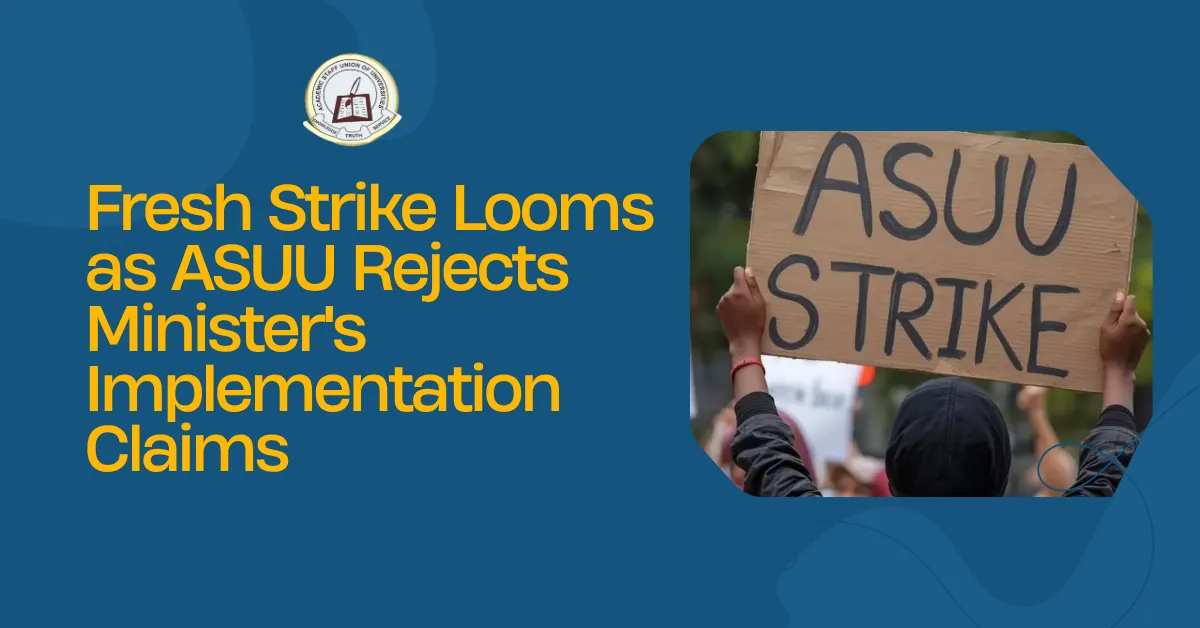
Five months after the Federal Government and the Academic Staff Union of Universities signed a landmark agreement to end years of dispute, the union has warned that Nigerian universities may be heading towards another round of industrial action over what it describes as deliberate and distorted implementation of the December 2025 deal.
The warning was issued on Monday by the ASUU Abuja Zone at a press conference held at Nasarawa State University, Keffi, where Zonal Coordinator Adamu Alabdullahi directly contradicted claims by the Minister of Education, Dr Tunji Alausa, that the agreement had been fully implemented.
Alabdullahi stated that rather than a coordinated national framework, the Federal Government had transmitted a memorandum to university councils in February 2026, leaving individual institutions to apply the agreement independently. "What has been witnessed so far is a distorted implementation of the agreement that is obviously anchored on a memorandum transmitted from the Honourable Minister of Education to Councils of Federal Universities in February 2026," he stated.
A key grievance raised was the government's failure to inaugurate the Implementation Monitoring Committee, which was designed to ensure uniform execution of the agreement and prevent bureaucratic bottlenecks. The union alleged that without this committee, university administrators were "picking and choosing" which allowances to pay, including the Consolidated Academic Tools Allowance, Earned Academic Allowance, and Professorial Allowance, rather than integrating them properly into salary structures.
ASUU listed several unresolved welfare issues affecting its members, including arrears of the 25 to 35% salary award, promotion arrears, unpaid pension contributions, unremitted third party deductions such as check off dues and cooperative contributions, salary shortfalls linked to the Integrated Personnel and Payroll Information System, and withheld salaries covering three and a half months arising from the 2022 industrial action.
The union also criticised the continued application of the "No Work, No Pay" policy against lecturers who participated in the 2022 strike. "No country can progress when the welfare issues of academics are left unattended. Reducing scholars to menial workers whose livelihood is tied strictly to physical presence at work does not reflect the realities of academic work, where research and community service continue even during strike periods," Alabdullahi stated.
On university governance, the union condemned the introduction of titles such as "Professor of Practice" and "Diaspora Professors" without approval from statutory university bodies, alleging that such practices had allowed individuals with questionable academic credentials to enter and rise within the system.
Some state governments were also faulted for failing to implement key aspects of the agreement despite their representatives participating in the negotiation process.
"Government must urgently resolve all outstanding issues to avoid a breakdown of industrial harmony in our universities," Alabdullahi warned.

Leave a Reply