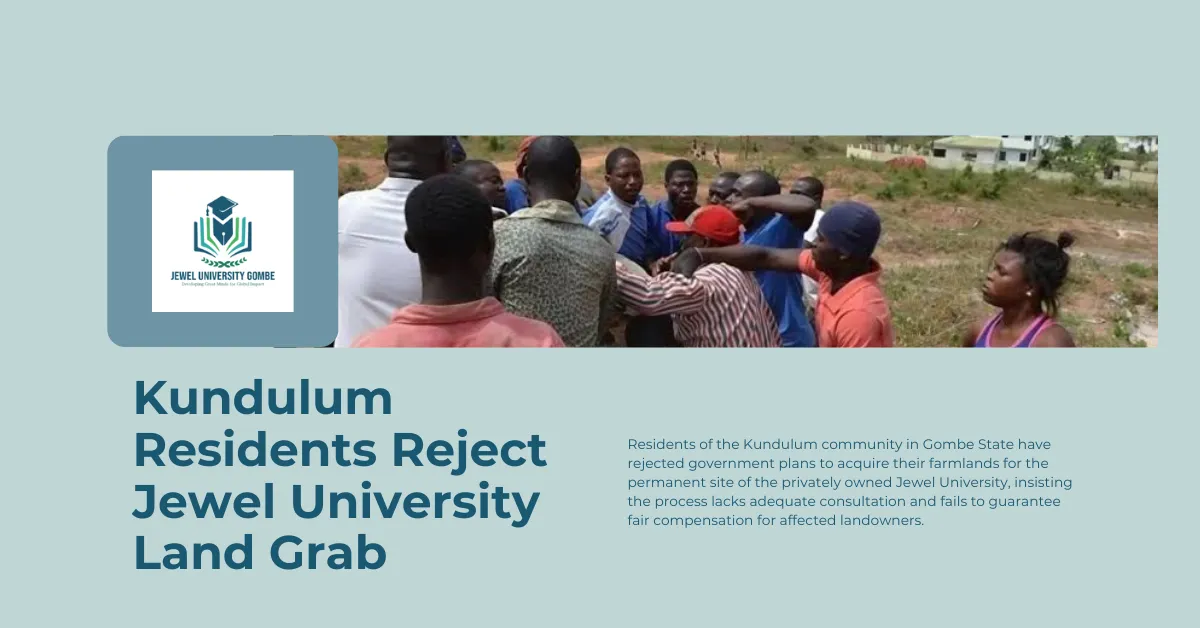
Residents of the Kundulum community in Gombe State have rejected government plans to acquire their farmlands for the permanent site of the privately owned Jewel University, insisting the process lacks adequate consultation and fails to guarantee fair compensation for affected landowners.
The Chairman of a recent town hall meeting, Alhaji Shuaibu Gara, argued that compulsory acquisition for a privately owned Institution should not be treated as a project executed in the overriding public interest. He maintained that the community was not opposed to educational development but insisted that residents' rights and livelihoods must be respected throughout the process.
Gara disclosed that officials had already begun demarcating approximately 110 hectares of farmland despite what he described as insufficient engagement with those who own and cultivate the land. He alleged that the compensation proposed falls significantly below the properties' actual value, leaving many residents dissatisfied.
Community leaders, farmers and other stakeholders who attended the meeting unanimously called on the government to suspend the acquisition process and embrace dialogue with indigenous landowners before proceeding further.
Representatives recalled that Kundulum had, over the years, surrendered large portions of land for major public projects, including Gombe State University, the Federal College of Education, the Livestock City project and a public market, yet received limited economic benefits, employment opportunities or infrastructure in return.
The residents appealed directly to the management of Jewel University to open discussions with landowners instead of relying on compulsory government acquisition, arguing that voluntary negotiations would foster trust, reduce tension and build a mutually beneficial relationship between the Institution and its host community.
They also urged the Gombe State Government to ensure any future acquisition process is conducted transparently, with adequate consultation, respect for property rights and compensation reflecting prevailing market realities.
Several affected farmers voiced concern over the potential consequences of losing their agricultural land, describing farming as their principal means of livelihood. They warned that the proposed takeover could threaten household incomes, food production and the long term economic stability of many families in the community.
The landowners consequently appealed to the authorities either to allow them to retain their farms or to redesign the acquisition process in a way that safeguards their interests while balancing the state's educational development objectives, stressing that meaningful engagement remains the most effective path toward resolving the dispute peacefully.



Leave a Reply