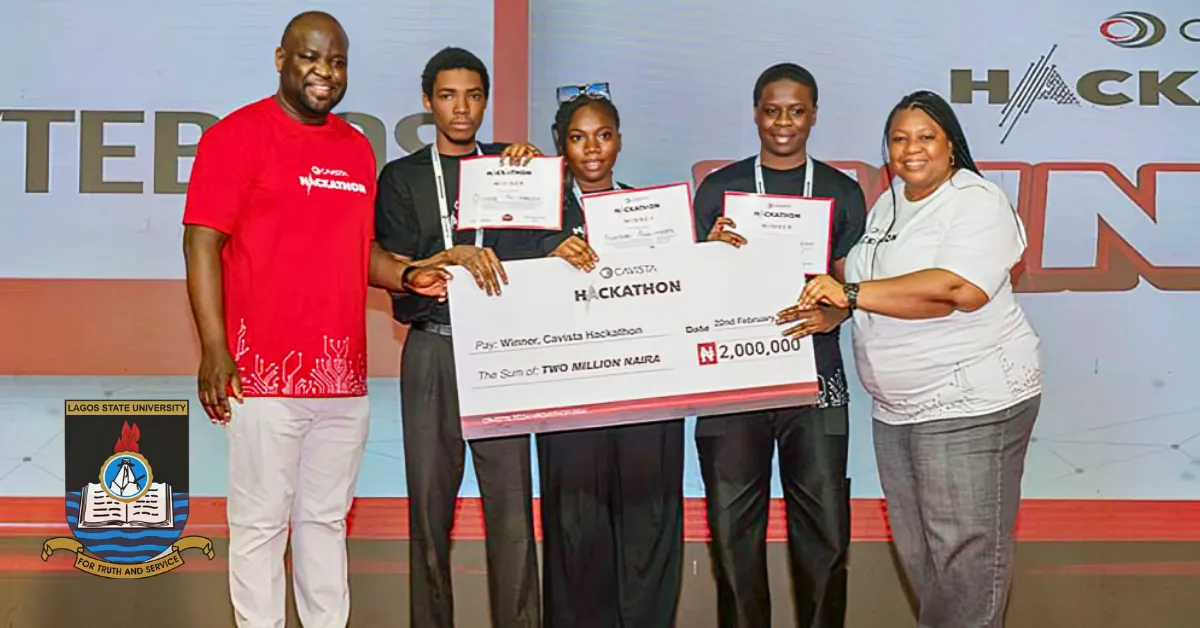
Five hundred students from multiple Lagos universities competed in the fourth Cavista Hackathon 2026, with Lagos State University's team, BryteBros, securing the top position and walking away with ₦2 million.
The competition, themed 'From Data to Prevention, AI as your Health Partner', demonstrated remarkable growth from its inaugural edition, which attracted just over 100 participants, according to tech blogger and judge Ifeanyi Nnamdi Okagbue.
Pan Atlantic University's team Mannalon and Lagos State University of Science and Technology's team Nibble finished in second and third positions, earning ₦1 million and ₦500,000, respectively.
During the event, organisers gave out five more awards: Team Excellence won the Dream Team Award, Team Plugins took the Best Implementation Award, Team Unik earned the Best Use of Specific Technology Award, Team Bug Busters received the Tech Visionary Award, and Team Sync got the Creativity Spark Award. Mrs Oyebola Morakinyo, General Manager of Cavista Technologies, spoke about worries that Artificial Intelligence might replace software engineers, but she emphasised that the technology is meant to boost human skills.
"We are not afraid of AI. We don't see AI as replacing human beings. We see AI as multiplying the skill sets of human beings," Morakinyo stated.
She explained that Cavista integrates AI knowledge into its training programmes to ensure engineers remain relevant, emphasising that software engineers must continuously develop advanced competencies that AI cannot easily replicate.
Morakinyo described the programme's outcomes over four years as significant and multi layered, noting that participating students gain confidence, mentorship access, practical tools, and structured feedback that help them refine ideas and build deeper technology solutions.
She stressed that investing in young people's digital capacity remains critical to Nigeria's future competitiveness, linking the initiative to national economic growth.
Addressing brain drain concerns in the technology sector, Morakinyo acknowledged the challenge but highlighted private sector efforts to retain talent by giving young professionals stronger voices and reinforcing the global relevance of their skills.
"You don't need to leave the country. You can export your knowledge from here," she stated.
Nnamdi Okagbue revealed that entries were assessed using four criteria, including technology, design, market fit, and presentation quality, with judges scrutinising whether proposed solutions could genuinely solve real problems.
He noted that increasing student participation indicates more young Nigerians are positioning themselves for technology ecosystem opportunities, with some past winners now employed by Cavista Technologies, while others secured opportunities in different organisations.
Minister of Arts, Culture, Tourism and the Creative Economy, Hannatu Musawa, who spoke virtually, urged young innovators to leverage technology driven platforms to develop solutions transforming Nigeria's economy, commending organisers for investing in youth talent development.

Leave a Reply