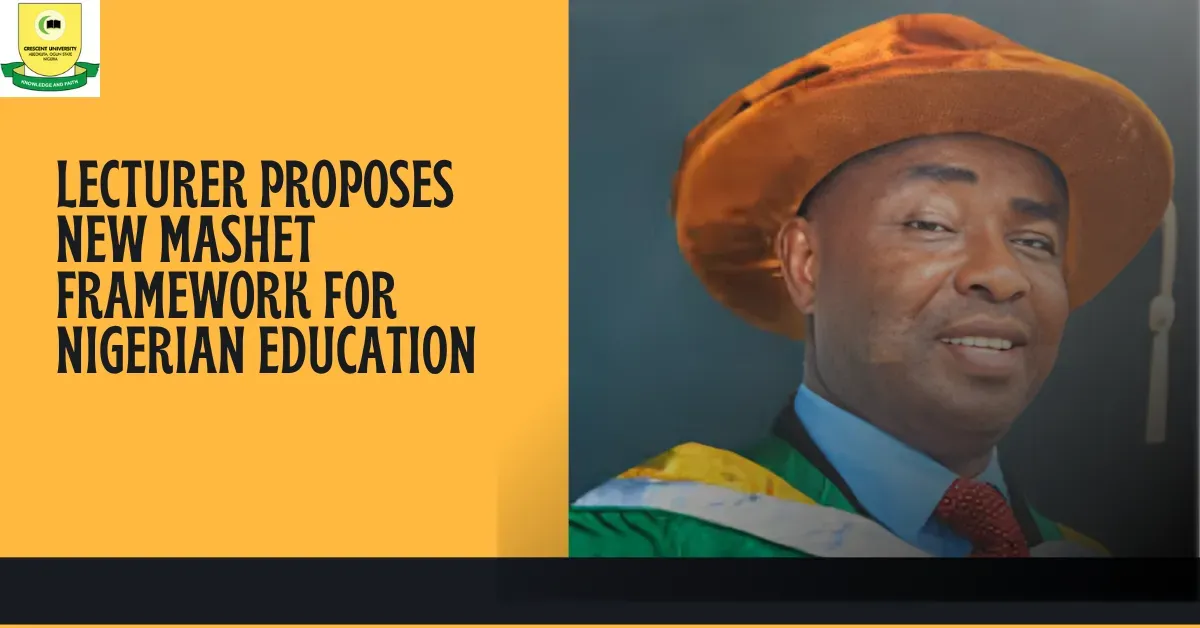
A lecturer at Crescent University, Abeokuta, in Ogun State, Dr Kola Adesina, has introduced a new educational framework called MASHET, which seeks to restore humanities to the widely adopted Science, Technology, Engineering, and Mathematics curriculum and its variant, STEAM.
Adesina, who serves as Head of the Department of Mass Communication, explained that both STEM and STEAM have failed to adequately integrate the humanities, a discipline he described as essential for human development, ethical reasoning, and social responsibility. He maintained that the missing letter "h" represents not a cosmetic addition but a fundamental repositioning of how formal education should be structured in the twenty first century.
According to him, both STEM and STEAM have, over the past two decades, produced technically proficient graduates, yet the absence of the humanities has left many students lacking in critical thinking, ethical judgment, and communication skills. "STEM and STEAM have produced excellent technical minds over the past 20 years, but they have largely ignored social engineering, leading to inadequate thinking in many instances," he stated.
Adesina disclosed that he developed the MASHET concept after two decades of reflection and study, a journey that began with his postgraduate certificate in education at Canterbury Christ Church University in the United Kingdom. He noted that his observations of students across Africa, including his own, revealed that many excelled in technical subjects but struggled with critical analysis, ethical reasoning, persuasive writing and the ability to interrogate the societal impact of innovation.
He pointed to the wider global conversation around education reform, which has increasingly questioned the dominance of STEM. In 2023, UNESCO called for greater integration of social and human sciences into science education, cautioning that technical education without humanistic grounding could deepen inequality and create ethical blind spots in innovation.
Under the MASHET framework, learners across all disciplines would be trained to ask probing questions, with emphasis placed not on reducing technical skills but on balancing them with context, moral reasoning, and storytelling. Adesina explained that humanities, when properly taught, equip students to understand history, interpret culture, evaluate power, and communicate ideas clearly, capacities he said machines and algorithms cannot replicate.
Reactions among African educators have been mixed. While some described the framework as long overdue, others expressed concern that adding another letter to the acronym could dilute focus on technical skills still scarce and urgently needed for economic growth. Responding to this, Adesina insisted that the goal is not to subtract from science and technology but to deepen them. "In Europe today and some other parts of the world, there is widespread recognition of the inadequacy of the focus on STEAM to the detriment of the societal values of humanity, ethics, contextual thinking, and other social engineering courses," he remarked.



Leave a Reply