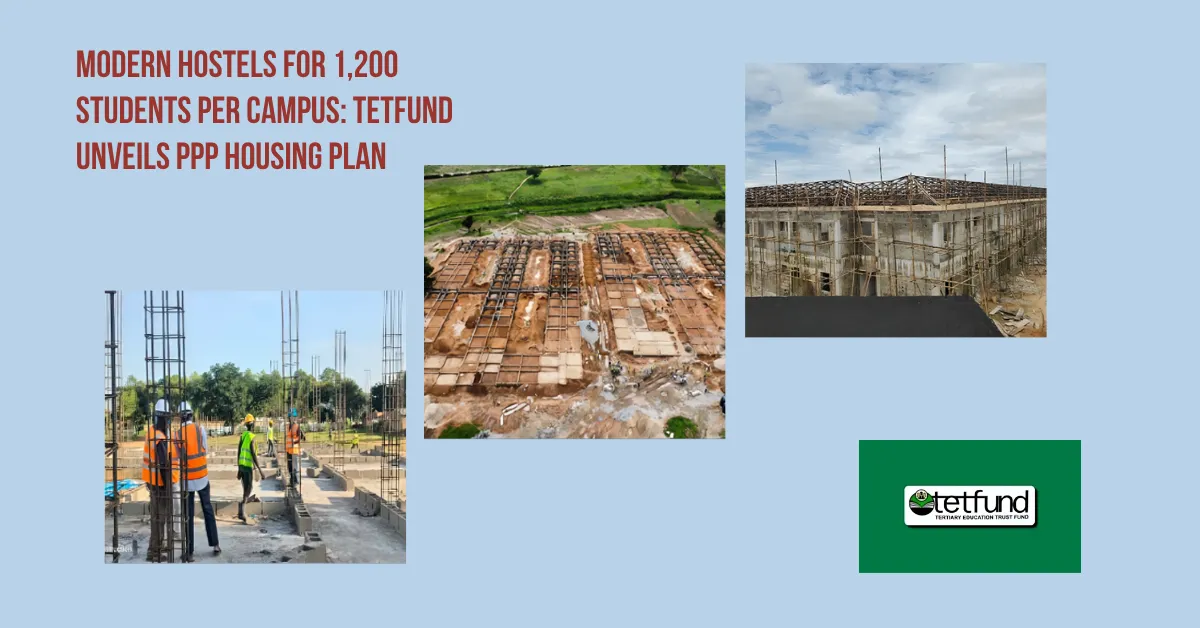
Hundreds of thousands of Nigerian University students could soon leave behind decades of overcrowded, crumbling hostels as the Tertiary Education Trust Fund launches a N4 billion Public Private Partnership initiative to deliver modern student accommodation across public Universities, Polytechnics and Colleges of Education Nationwide.
The programme, approved by President Bola Ahmed Tinubu under the Federal Government's Special Intervention scheme and captured in the 2026 Disbursement Guidelines, represents one of the most significant investments in student housing infrastructure in Nigeria's recent history. Under the arrangement, private investors will fund 75% of project costs, with TETFund contributing the remaining 25% as counterpart funding on behalf of beneficiary institutions.
"The project is valued at N4 Billion, with the provision of 75% funding by the interested investor and 25% as counterpart contribution by TETFund on behalf of the beneficiary institutions," the Fund stated.
The initiative will follow a Design, Build, Finance, Maintain, Operate, and Transfer model, under which private investors will manage the hostels for a concession period of between 21 and 30 years before ownership reverts to the Institutions. Each facility must provide a minimum of 1,200 bed spaces for both male and female students, with rooms ranging from single to double occupancy and no more than four students sharing any room. Hostels will also include essential utilities, study areas, and recreational facilities designed to support academic focus and personal development.
Prospective Investors are required to demonstrate the financial and technical capacity to execute projects of this scale, including a contribution of N3 billion as equity for the 75% share of the N4 billion project. Registration with the Securities and Exchange Commission and compliance with the Infrastructure Concession Regulatory Commission are mandatory, alongside relevant certifications under the National Policy on Public Private Partnerships. Investors will also be required to establish a Special Purpose Vehicle with the beneficiary institution and submit an Outline Business Case, detailed architectural drawings, and a Bill of Quantities to ensure full regulatory compliance.
Applications will be assessed on merit and must receive the approval of the governing councils of participating institutions. They will be processed on a first come first served basis, with a deadline of 6 April 2026. Interested parties are directed to liaise with beneficiary institutions listed on the TETFund website.
Beyond bricks and mortar, the initiative carries broader implications for Nigeria's higher education landscape. For decades, inadequate student housing has compromised both safety and academic performance, with many students forced into unsafe private accommodation far from campus. The introduction of well managed, modern hostels is expected to improve retention rates, boost academic outcomes, and enhance student satisfaction across Institutions.
The construction and operation of the new facilities are also expected to generate employment, stimulate local economies, and establish a replicable model for future collaborations between Public Institutions and private capital in the education sector.
For Nigerian University Students who have long endured conditions unworthy of any Institution of learning, the N4 billion initiative is more than a construction project. It is, if delivered on its promise, the beginning of a new standard for what campus life in Nigeria can and should look like.



Leave a Reply