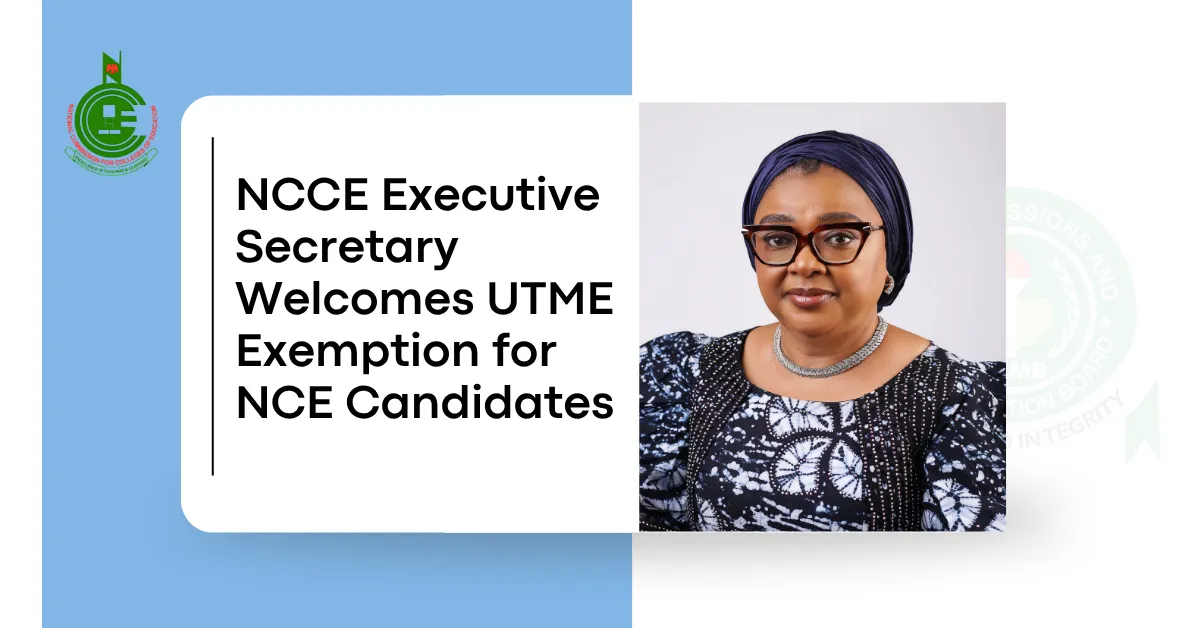
The Executive Secretary of the National Commission for Colleges of Education, Dr Angela Ajala, has thrown her weight behind the Federal Government's decision to exempt candidates seeking admission into Colleges of Education from writing the Unified Tertiary Matriculation Examination, describing the reform as a timely intervention for Nigeria's teacher education sector.
Ajala welcomed the policy, which takes effect from the 2026/2027 academic session, noting that it widens access to teacher training without compromising the integrity of the admission process. She pointed out that candidates are still required to register with JAMB and have their credentials screened, verified, and processed through the Central Admissions Processing System before admission letters are issued.
The NCCE boss drew attention to the growing crisis in Nigeria's basic education sector, warning that the country faces a shortage of qualified teachers, declining enrolment in Colleges of Education, and reports that some states had gone five years without recruiting a single teacher, with some institutions recording zero first year intake.
"If implemented well, these reforms can help rebuild public confidence in teacher education, attract stronger candidates, improve the identity of Colleges of Education, and create a new generation of teachers who are prepared not only to teach, but to transform learners," Ajala stated.
She stressed that the teacher of the future must go beyond subject instruction, emphasising the need for digital competence, entrepreneurial thinking, emotional intelligence, and strong pedagogical grounding suited to 21st century classrooms.
Ajala also framed the JAMB waiver as part of a broader repositioning agenda aimed at making Colleges of Education more attractive, globally relevant, and nationally respected.
The policy was announced by the Minister of Education, Dr Tunji Alausa, at the admission policy meeting for the 2026 UTME. Alausa noted that candidates with a minimum of four credit passes in relevant subjects are now eligible to apply to Colleges of Education without sitting the examination.
"It will not only ease the pressure associated with UTME but also encourage greater participation in teacher education and agricultural programmes, both of which are critical to national development," the minister noted.
The exemption also covers candidates applying for National Diploma programmes in non technology agricultural and agriculture related courses.

Leave a Reply