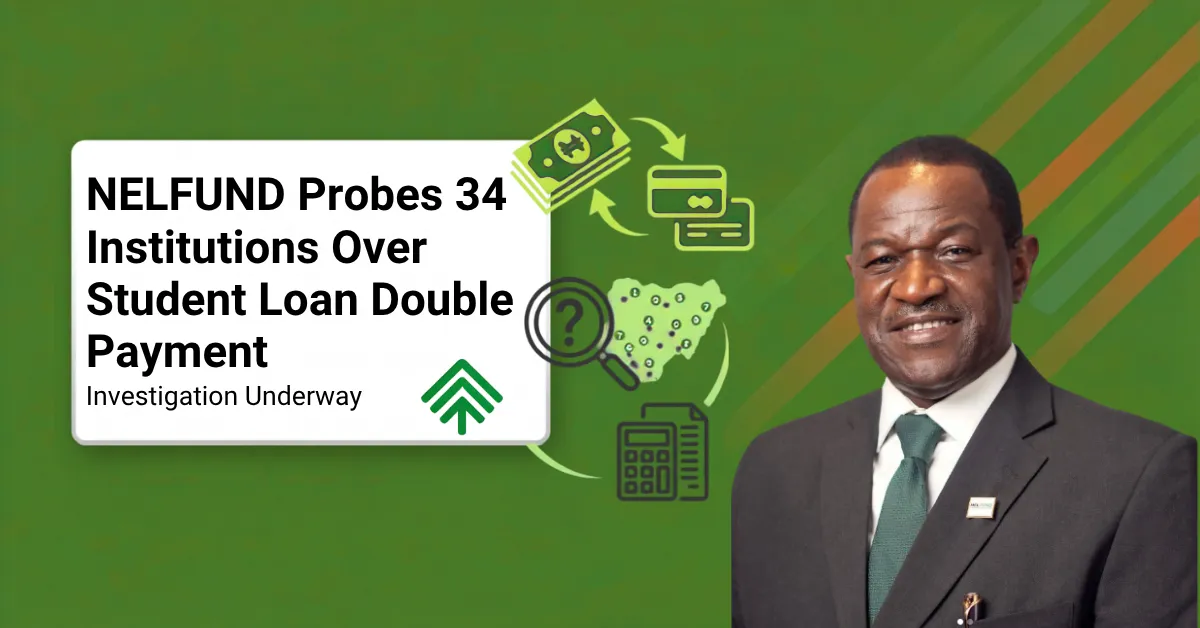
The Nigerian Education Loan Fund has launched investigations into 34 tertiary institutions accused of withholding refunds owed to students whose tuition fees were paid twice under the Federal Government's student loan scheme.
NELFUND's Managing Director, Akintunde Sawyerr, disclosed this during an interview with ARISE NEWS on Sunday, stating that the agency acted following a surge in complaints and petitions from affected beneficiaries.
Sawyerr confirmed that the probe is being conducted in collaboration with anti corruption agencies, the National Association of Nigerian Students, internal auditors, and other stakeholders. "I can tell you that there are about 34 institutions that we are looking at at the moment because of the number of petitions we've received," he said.
The Managing Director traced the problem to a presidential directive. President Bola Tinubu ordered the immediate rollout of the student loan scheme midway through an academic session rather than at the start of a new academic year. Consequently, many students had already settled their tuition before NELFUND subsequently paid the same fees directly to their institutions, generating duplicate payments.
"What happened is that a lot of schools got double payment. Some from the students, some from us. The refund process is entirely out of our hands. It is the recipient of the double payments that is obliged to make refunds to the students," Sawyerr stated.
He stressed that the matter was urgent for many beneficiaries who borrowed funds from parents and relatives to cover fees before accessing the loan. "Most students in this country are hard up. They don't have enough money for themselves. So when they make a payment for their education, and then they take a loan for the same education, they expect their money to be refunded to them. Some of them have borrowed the funds, their parents have borrowed the funds, and they need to repay those funds," he said.
While acknowledging that some institutions had responded promptly, Sawyerr noted that others had delayed, though he reserved judgement on whether the delays were deliberate or administrative in nature.
To prevent a recurrence, NELFUND is developing a token based payment system enabling students to authorise tuition payments directly from their mobile phones. The agency also admitted it lacks statutory powers to compel refunds or prosecute offending institutions, with frustrated students submitting petitions directly to the EFCC and the ICPC.
A multi agency team has since been deployed to investigate one institution specifically accused of withholding refunds. Sawyerr additionally revealed that some schools attempted to raise tuition fees after realising NELFUND would settle approved charges directly. The agency refused. "Some schools, because they get paid easily, started to put up their fees. We refused, point blank, to pay institutions who had hiked their fees beyond a certain level," he stated.


Leave a Reply