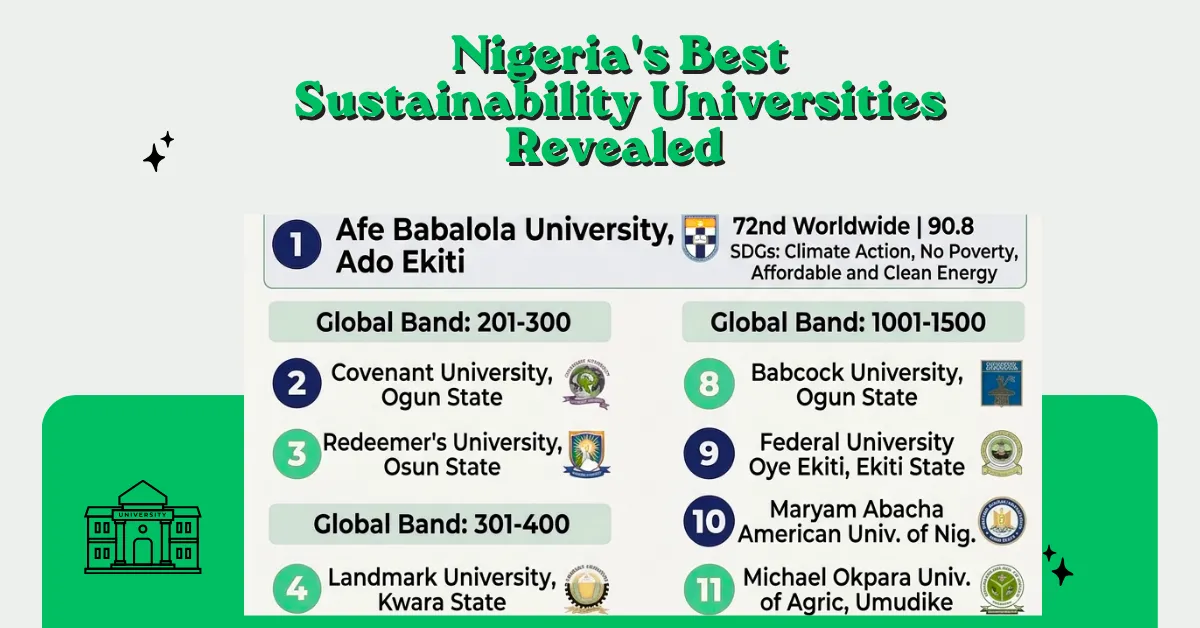
Afe Babalola University, Ado Ekiti, has become Nigeria's Highest Ranked University in the 2026 Times Higher Education Sustainability Impact Ratings, placing 72nd worldwide and standing as the only Nigerian institution to break into the global top 100.
Released on Wednesday by Times Higher Education, the rankings assessed 1,646 Universities across 116 countries and territories on their contributions to the United Nations Sustainable Development Goals. ABUAD recorded an overall score of 90.8, earning strong ratings in Climate Action, No Poverty, and Affordable and Clean Energy.
The private university also finished second in Africa, behind the University of Johannesburg, South Africa, which placed 39th globally.
Among Nigerian Universities, Covenant University and Redeemer's University followed ABUAD in the 201 to 300 global band, with Landmark University placed in the 301 to 400 category. The University of Lagos fell within the 601 to 800 band, while American University of Nigeria and Lagos State University were placed in the 801 to 1000 range.
In the 1001 to 1500 band, eight Nigerian Institutions featured: Babcock University, Federal University Oye Ekiti, Maryam Abacha American University of Nigeria, Michael Okpara University of Agriculture, Umudike, Nile University of Nigeria, Obafemi Awolowo University, Pan Atlantic University, and the University of Nigeria, Nsukka.
Five institutions appeared in the 1501 and above category: Al Hikmah University, Bells University of Technology, Caleb University, Evangel University Akaeze, and Godfrey Okoye University.
At the global level, the University of Manchester in the United Kingdom retained the top position, while Griffith University in Australia ranked second.
They noted that Institutions qualify for the overall ranking by submitting data for SDG 17 on Partnerships for the Goals, alongside at least three other SDGs. The assessment covers research output, environmental stewardship, community engagement, and teaching activities tied to sustainable development across all 17 SDGs.
The 2026 edition also introduced universities from Mali, Nicaragua, Niger, and Tajikistan. The Philippines had the highest number of participating institutions, with 160 Universities represented.



Leave a Reply