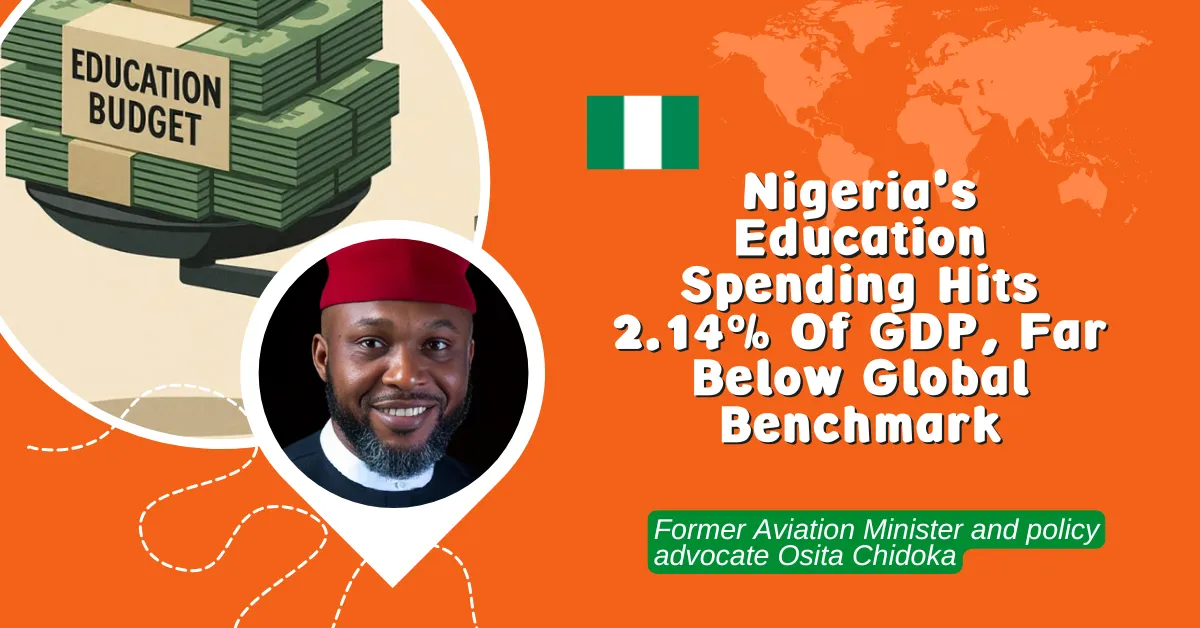
Twenty seven years after Nigeria's return to democratic governance, the country's total education spending in 2026 amounts to just 2.14% of its Gross Domestic Product, a figure that former Aviation Minister and policy advocate Osita Chidoka has described as a national emergency.
Chidoka made the declaration while delivering a keynote address at the 70th Anniversary Gala of the Ekulu Primary School Alumni Association in Enugu, presenting an analysis compiled by the Athena Centre for Policy and Leadership, which he leads as Chancellor.
The Athena Centre consolidated federal education spending, interventions by the Universal Basic Education Commission and the Tertiary Education Trust Fund, alongside education allocations from Nigeria's 36 states and the Federal Capital Territory. The combined figure reached approximately ₦9.49 trillion against Nigeria's projected 2026 GDP of ₦442.8 trillion, placing the country well below the UNESCO recommended benchmark of 4% to 6% of GDP for developing nations.
Chidoka benchmarked Nigeria against peer economies, noting that South Africa allocates 6.7% of GDP to education, Brazil 5.6%, Kenya 4.8%, India 4.1%, and Ghana 3.4%. "Nigeria is not in the middle of the developing world on this measure. It is below its floor," he stated.
The analysis identified Anambra State as the federation's highest education spender, committing 46.9% of its 2026 budget to the sector. Enugu State followed at 32.2% and is currently rolling out its Smart Green Schools initiative across all political wards. Kano, Lagos, Kaduna, Katsina, and Abia were also cited, with the six states projected to collectively spend ₦1.8 trillion on education in 2026. The report noted that despite Lagos State's large absolute education expenditure, only 5.6% of its total budget went to the sector, adding that Enugu's education budget in dollar terms now stands at roughly twice that of Lagos.
Chidoka traced the roots of the crisis to Nigeria's structural adjustment era between 1986 and 1999, during which a professor's monthly salary reportedly fell from $1,000 in 1985 to $137 by 1997, and Lagos State's real per pupil spending collapsed from $281 in 1980 to $22 in 1990. He argued that the greater failure came after 1999, when successive democratic governments chose not to reverse those declines despite improved economic conditions.
He challenged the alumni association to deliver three measurable interventions within three years: a data driven student outcomes dashboard, a teacher development and recognition fund, and integration of Ekulu Primary School into Nigeria's digital education infrastructure through the Nigerian Research and Education Network. "Let's Get It Done is not charity. It is repayment," he said.
Ekulu Primary School, founded in 1956 as All Saints School by Reverend Timothy Bruce Fyffe of the Church of England, predates Nigerian independence and remains one of Enugu State's enduring public primary institutions.



Leave a Reply