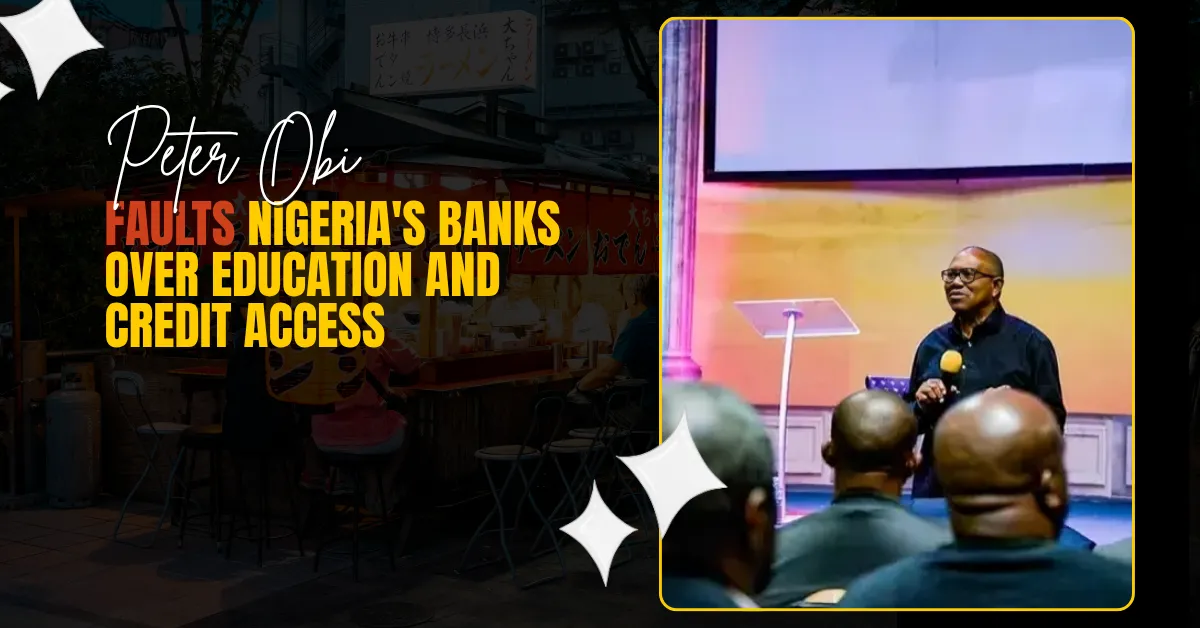
Peter Obi has aimed at Nigeria's financial system, arguing that the country's banks consistently fail to recognise education and intellectual capacity as legitimate assets for accessing credit, a practice he contrasted sharply with his own experience borrowing money in the United Kingdom.
Obi made the remarks at the Spier Dialogue 2026 in Cape Town, South Africa, where he addressed members of the Nigerian community ahead of broader discussions on governance, democracy, economic inclusion, and leadership across Africa.
Drawing from personal experience, the former Anambra State Governor disclosed that British financial institutions once granted him business loans based primarily on his academic background rather than physical collateral or family wealth.
"I lived in the UK and did business there successfully. I went to the bank and told them the schools I attended, Cambridge and Oxford, and they gave me money. They trusted intellectual capital," Obi stated.
He contrasted that experience with what he described as Nigeria's rigid, collateral-driven lending culture. "In Nigeria, they would ask you to bring properties, family documents, and all sorts of guarantees before considering your request," he added.
The former Labour Party presidential candidate used the platform to advance his argument that Africa must transition from consumption-driven economies to production oriented systems capable of empowering young people and encouraging enterprise development. He further argued that governance must focus on building institutions that support productivity and economic inclusion rather than systems driven by political transactions.
In a statement shared on his social media platform following his arrival in South Africa, Obi described the Spier Dialogue as an important continental forum addressing Africa's most pressing challenges. He noted that conference discussions covered governance, migration, urbanisation, economic inclusion, democracy, and leadership development across African countries.
Obi also argued that Africa must not remain a continent rich in resources yet plagued by poverty, inequality, and weak Institutions, stressing that competence driven leadership and practical reforms are urgently needed.
His remarks have resonated with young Nigerians and professionals on social media, many of whom contend that the country must invest more seriously in human capital development to remain competitive in the global economy. Education analysts have long identified restricted access to credit as one of the most significant barriers facing entrepreneurs and graduates in Nigeria.



Leave a Reply