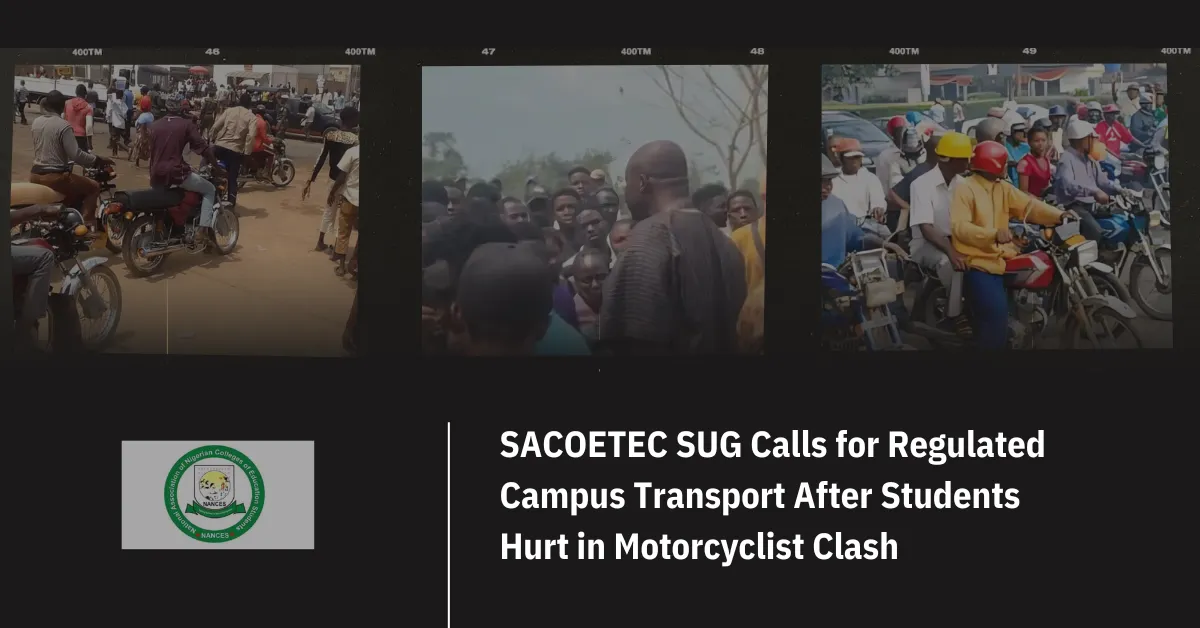
A violent clash between students and commercial motorcyclists near a Nigerian College of Education has prompted the institution's student union to demand not only compensation for those injured but a complete overhaul of how motorcycle operators are allowed to function around the campus.
The Students' Union Government of Sikiru Adetona College of Education, Science and Technology raised the alarm in a letter dated 11 March, addressed through the Dean of Students' Affairs, following an incident that occurred on 10 March 2026. Three students were caught up in the clash: Salisu Adewunmi, Esther Afolabi, and Popoola Oluwasegun. Two sustained injuries that required hospital treatment and stitching.
The union is demanding that the motorcyclists cover the full cost of medical treatment for the injured students, put at N350,000 in total. Adewunmi's treatment alone accounts for N250,000 of that figure, with Afolabi's care estimated at N100,000. The union is also seeking compensation for property allegedly lost during the incident, including an Acer Chromebook laptop valued at N750,000 belonging to Adewunmi and two G-Shock wristwatches reportedly owned by Oluwasegun.
On the question of long term safety, the Union has set out a series of demands directed at school management. It is calling for a stakeholders' meeting bringing together college authorities, community leaders, and the leadership of the motorcyclists' association to agree on measures that would protect students going forward. It has also asked management to introduce a regulated fare system for motorcycle rides within and around the campus and to require all commercial operators in the area to register with the institution and carry identification issued by the college.
The letter was copied to the provost, the Divisional Police Officer of Omu Police Station, and traditional rulers in the surrounding communities.
The Union felt compelled to write to a police station and traditional rulers, alongside school management suggests the incident has stirred concerns that go beyond what the college can resolve on its own. For students who rely on commercial motorcycles as their primary means of movement around the campus, the outcome of these demands may determine whether that daily journey becomes safer or remains as unpredictable as it proved to be on 10 March.
Leave a Reply