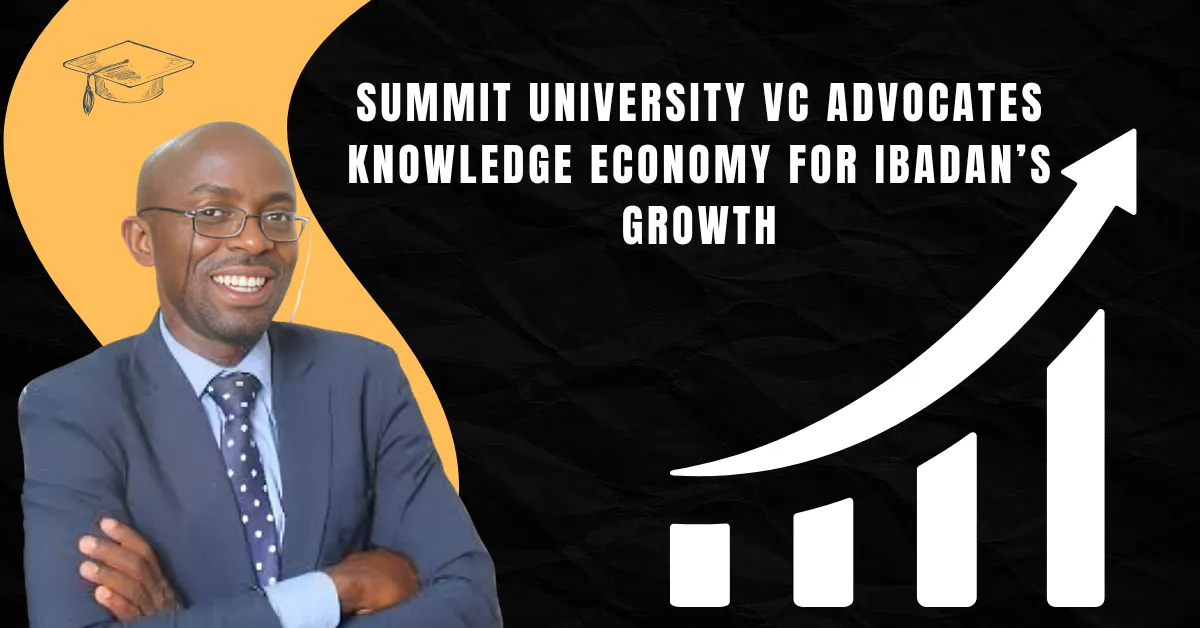
A call has been made for a deliberate transition to a knowledge economy to restore the lost glory of Ibadanland. The Vice Chancellor of Summit University, Offa, Professor Abiodun Aibinu, emphasized that the future of the ancient city depends on how well its institutions are structured to tackle current realities.
He made this assertion while delivering a paper titled “Ibadan, remembering our past, understanding our present, designing our future,” at the 2026 Ibadan conference. The event was organised by the Central Council of Ibadan Indigenes (CCII) in honour of the Olubadan of Ibadanland, Oba Rasidi Adewolu Ladoja.
Aibinu identified unemployment and infrastructural decay as the primary factors hindering the progress of the Oyo State capital. He lamented that Ibadan, which used to boast of numerous manufacturing industries, has seen these companies become moribund. He noted that the closure of these firms led to massive layoffs, contributing significantly to the high level of unemployment.
He also highlighted other challenges such as traffic congestion, flooding, and poor housing plans. He observed that the infrastructure that served the city in the past is no longer adequate.
To address these issues, the Vice Chancellor proposed a synergy involving three key groups. "Now it is all about the knowledge economy; we need to change our system. The Mogaji must be integrated, the CCII has a role, and the last one is the Olubadan in council. What we are saying is that if we don’t design our future, it will not be proper,” Aibinu stated.
He emphasized that, with the necessary structural adjustments, Ibadan can compete globally with its peers. The event was attended by notable indigenes, including Dr. Kazeem Adeduntan, Pro Chancellor of Abiola Ajimobi Technical University, and Barrister Ajeniyi Ajewole, President General of CCII.
Adeduntan noted that the lecture was crucial for planning the future of the city. The conference also featured awards for distinguished indigenes who have contributed to the cultural and economic development of Ibadanland. Aibinu concluded that the collective effort of the Mogajis, CCII, and the Olubadan in council is essential for meaningful transformation.

Leave a Reply