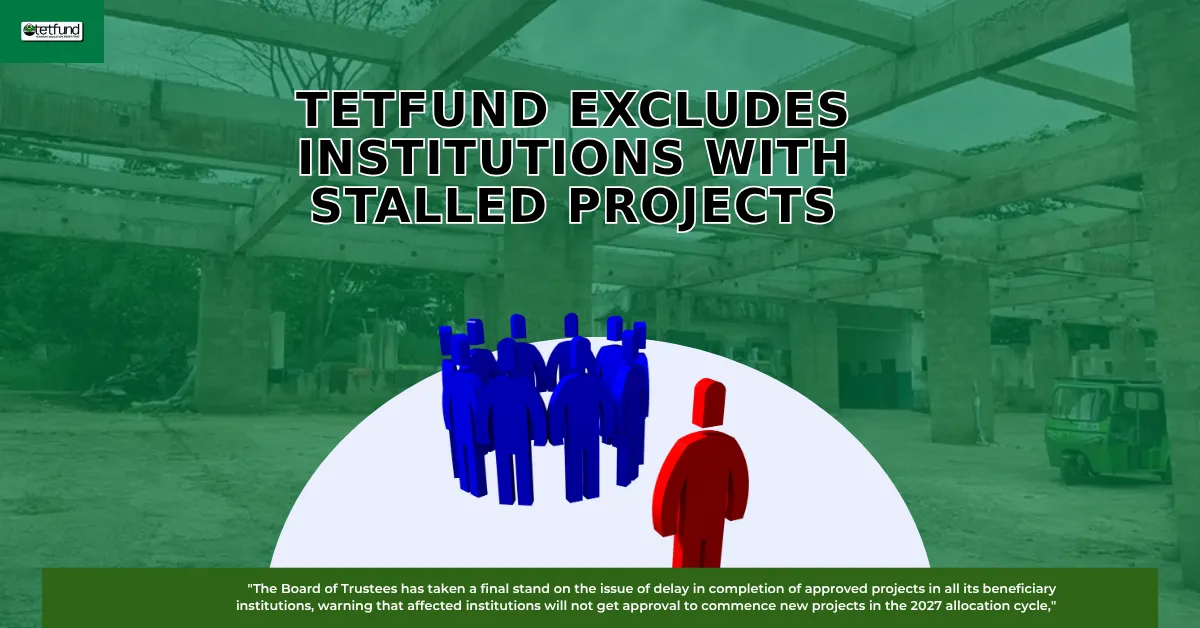
Tertiary institutions with outstanding TETFund projects face exclusion from the 2027 intervention cycle unless completion is prioritised, the Board of Trustees of the Tertiary Education Trust Fund has warned.
Chairman of the Board, Aminu Masari, disclosed that the directive followed persistent delays in executing approved projects across beneficiary institutions nationwide. A statement issued Wednesday by the Head of Public Relations, Abdulmumin Oniyangi, conveyed the resolution.
"The Board of Trustees has taken a final stand on the issue of delay in completion of approved projects in all its beneficiary Institutions, warning that affected institutions will not get approval to commence new projects in the 2027 allocation cycle," Masari stated.
Institutions with delayed projects have been directed to prioritise completion using their Annual, Zonal, and High Impact Intervention allocations. "No new projects will be admitted from the identified beneficiary institutions for the 2027 intervention cycle," Masari added.
Masari attributed the latest wave of delays largely to institutional leadership failures and administrative bottlenecks rather than funding shortfalls, noting that a lack of continuity among Heads of Institutions and delays in contractor payments remained key culprits. He acknowledged that a special intervention line introduced in 2023 had successfully addressed earlier delays caused by volatile prices of building materials such as cement and reinforcement bars.
Under the new measures, beneficiary institutions must compile comprehensive lists of projects exceeding their completion timelines by more than six months, identify causes of delay and propose practical remedies. Institutions are also required to rank affected projects by priority, provide detailed cost estimates and strengthen supervision mechanisms involving their Physical Planning and Maintenance Departments.
Masari revealed that TETFund monitoring teams comprising Board members and technical staff would conduct physical inspections of affected projects in August and September 2026. Findings and institutional proposals will then be reviewed at the Board's statutory meeting in October 2026, where eligibility for the 2027 disbursement guidelines will be determined.
TETFund, established under the Tertiary Education Trust Fund Act, remains Nigeria's foremost intervention agency for financing infrastructure, research, and staff development across public Universities, Polytechnics, and Colleges of Education, funded through a dedicated education tax on registered companies.



Leave a Reply