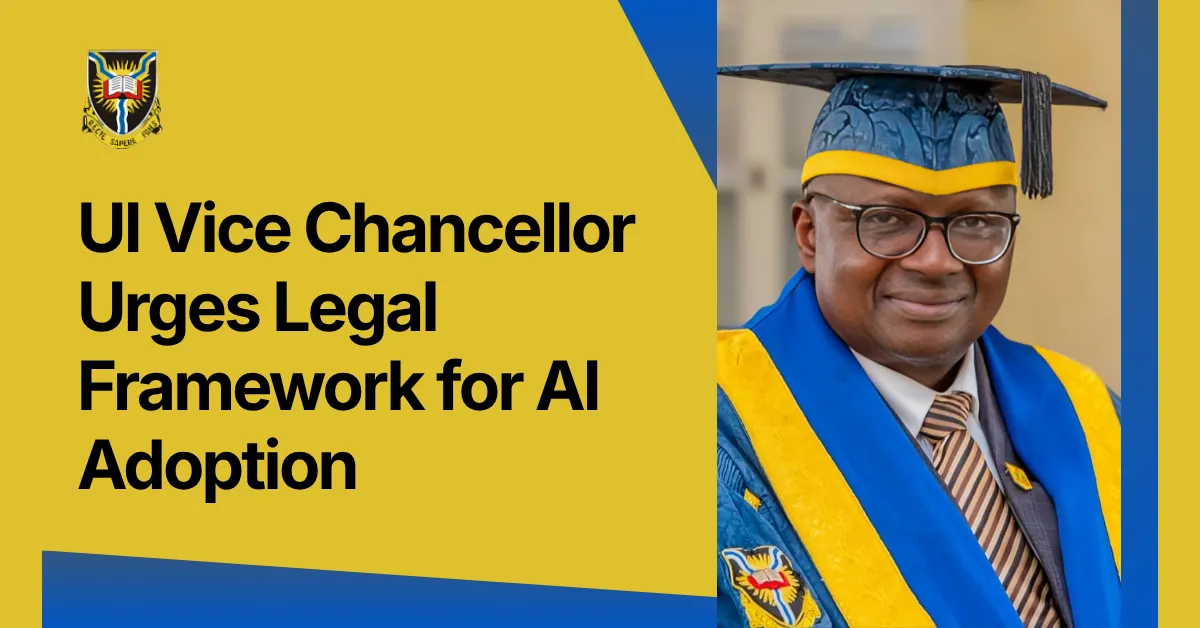
The University of Ibadan has called on businesses, entrepreneurs and policymakers to adopt artificial intelligence as a strategic driver of innovation and economic growth, with the Vice Chancellor, Prof. Kayode Adebowale, stressing the urgent need for national legal, ethical and regulatory frameworks to govern its deployment.
Adebowale made the call at the second annual symposium organised by the institution's Department of Marketing and Consumer Studies, held at the Kessington Adebukunola Adebutu Foundation Auditorium on the university's campus. The event was themed "Harnessing AI for Business Survival and Expansion in the Knowledge Economy."
The Vice Chancellor warned that while artificial intelligence is reshaping industries globally, its benefits could only be maximised through responsible governance and human oversight, advocating a dedicated national policy on AI and data sovereignty.
"We need a national policy on AI and data sovereignty. We must develop ethical and legal frameworks for AI. AI must not replace the human element, and there must be human oversight. Government must create an enabling environment, and we are ready for collaboration to sustain the momentum," Adebowale said.
The Head of the Department of Marketing and Consumer Studies, Dr. Samuel Orekoya, told participants that the technology had become the engine of the emerging knowledge economy and urged organisations to move beyond discussion into practical application.
"The business landscape is no longer merely competitive; it has become transformative. The knowledge economy is here, and at its heart is artificial intelligence. Our objective is not simply to discuss AI but to understand how it can be harnessed to help businesses survive, expand, and thrive in an increasingly competitive environment," Orekoya said.
He noted that the symposium was designed to bridge the gap between academic knowledge and industry practice, with experts drawn from technology, industry and public policy to examine AI applications in supply chain optimisation, customer experience management, marketing analytics and business model innovation.
In his keynote address, Chief Executive Officer of Cynergy Solutions Ltd., Dr. Oladipupo Sennaike, cautioned organisations against deploying AI without governance structures or ethical safeguards. Describing data as "the new oil," he argued that businesses responding swiftly to shifting consumer expectations would secure measurable competitive advantage.
"We have to be ethical about AI. It enhances decision making, saves time, improves productivity, and creates new business models. Organisations must develop AI policies and strategies because you do not simply adopt AI without a roadmap," Sennaike said.
The Dean of the Faculty of Economics and Management Sciences, Prof. Abiodun Folawewo, described the symposium as timely, noting that artificial intelligence was increasingly influencing business operations, research and higher education alike.



Leave a Reply