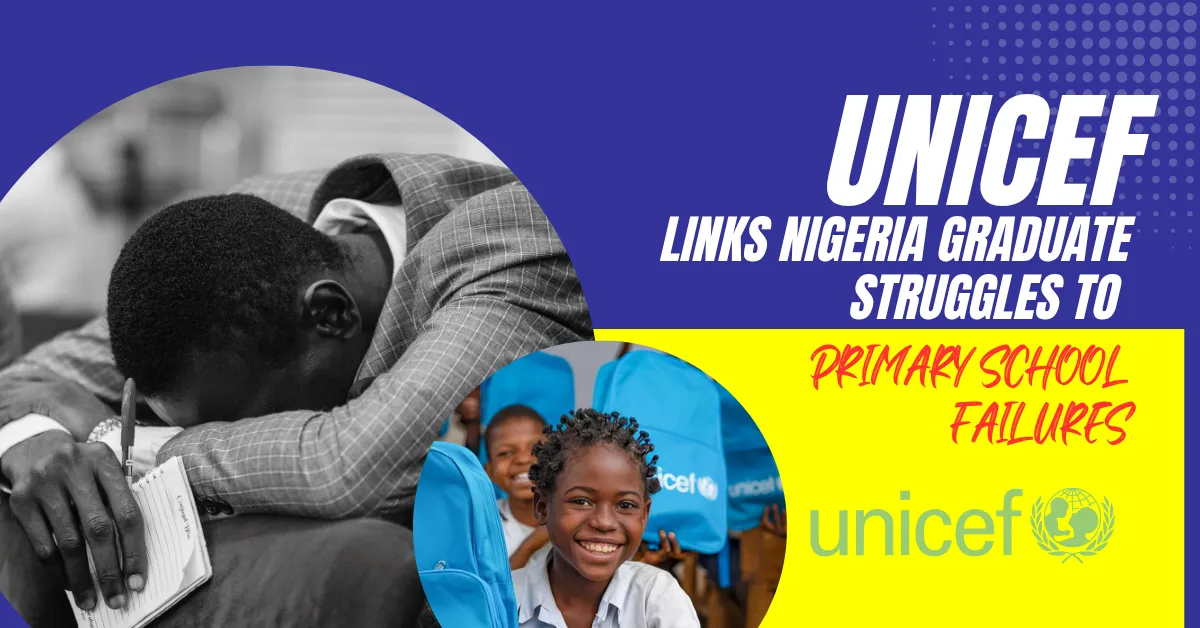
Nigeria's education system is failing at every level, UNICEF has warned, with poverty, population growth and collapsing learning outcomes creating a crisis that threatens the country's entire academic pipeline from primary school through to higher education.
UNICEF Education Specialist Harold Kpojime made this declaration at a two-day media dialogue on digital learning, artificial intelligence and skills development for out of school children held in Ede, Osun State. The event was organised by UNICEF in partnership with the Osun State Ministry of Education, the Federal Ministry of Education, the Universal Basic Education Commission (UBEC), and the Global Partnership for Education (GPE), and attracted journalists from Lagos, Ogun, Oyo, Osun, Ekiti, Ondo, and Edo States.
Citing the 2021 Multiple Indicator Cluster Survey (MICS), Kpojime disclosed that one in three primary school age children in Nigeria is not attending school, placing the country among nations with the largest populations of out of school children globally. The consequences, he warned, extend far beyond basic education.
Data presented at the dialogue showed that only 68.4% of primary school age children attend school nationally. Attendance falls to 47.6% at the Junior Secondary level and further to 46.7% at the Senior Secondary level, meaning the majority of young Nigerians never reach tertiary education with adequate foundational skills.
"It is no longer just about getting children into school; we are also dealing with poor learning outcomes. We have children in school who are not learning adequately," he stated.
Kpojime recalled witnessing the consequences of this failure at University level, where some peers struggled with basic English despite years of schooling. "That is the reality we face. It underscores the importance of language policy, as children learn better when taught in a language they understand," he said.
He identified population growth as an intensifying pressure across all tiers of education. "As the population rises, opportunities shrink because resources are not expanding at the same pace," he noted, adding that graduates increasingly question whether formal education delivers real economic returns.
"We encourage children to stay in school, but there is no guarantee of jobs after graduation. Some may feel they are better off learning a trade or starting a business," he said.
Teacher quality was flagged as a critical failure point, with many states going years without structured teacher training. "We must invest in teachers. They are central to addressing the learning crisis and reducing the number of out of school children," Kpojime stated.
To bridge learning gaps, he highlighted the Nigerian Learning Passport, developed by UNICEF, the Federal Ministry of Education and Microsoft, providing free curriculum aligned resources from early childhood through secondary education. Airtel has zero rated the platform, allowing access without data charges.

Leave a Reply