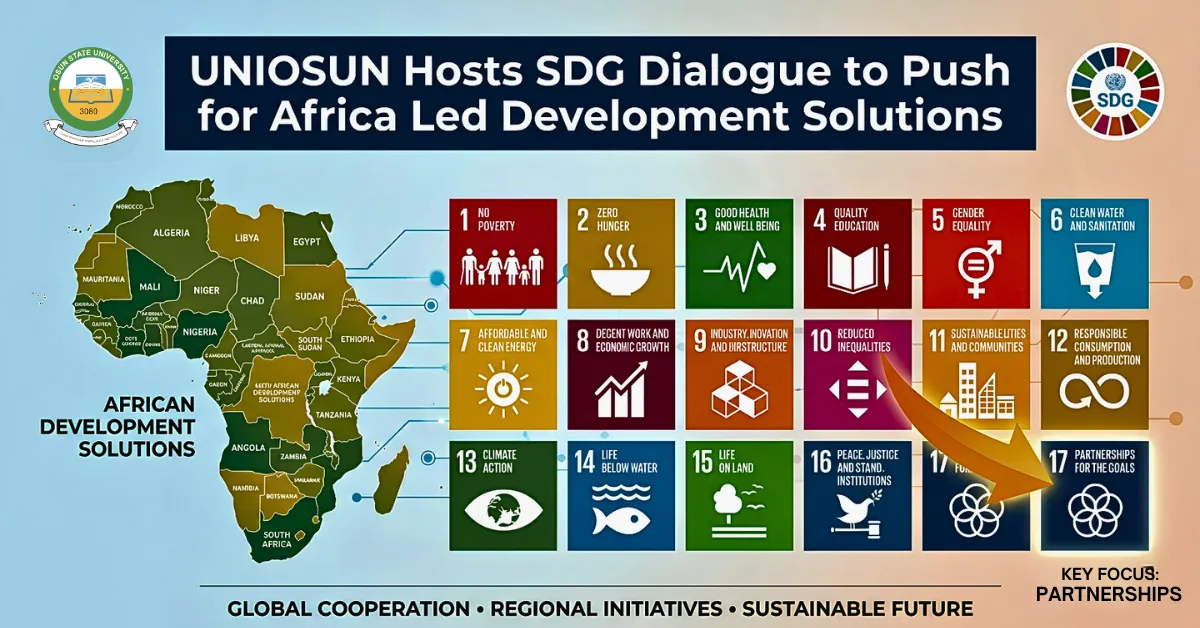
The Osun State University, Osogbo, has challenged the global development community to abandon uniform solutions imposed on African nations and adopt frameworks rooted in local realities, historical contexts and indigenous knowledge systems.
The Vice Chancellor, Prof. Odunayo Adebooye, delivered the charge at the opening of the 2026 International Sustainable Development Dialogue hosted by the university's Global Affairs and Sustainable Development Institute in partnership with Rosa Luxembourg Stiftung, Germany. The event was themed "The Problem with Solutions: SDGs and Global South Development Challenges."
Represented by the Deputy Vice Chancellor for Academic, Research, Innovation and Partnership, Prof. Adetunji Lawrence Kehinde, Adebooye argued that global development frameworks routinely suffer from a top down approach in which solutions designed in developed countries are exported to developing nations without adequate consideration for local conditions.
"Our task is to interrogate these ready made frameworks and challenge the shift from merely importing solutions to creating alternatives that respect our specific material realities," he stated.
He stressed that African universities must function as intellectual centres where global ideas are rigorously tested against local realities, rather than serving as passive consumers of externally designed development models. He described the Global South not as a testing ground for development interventions but as a source of innovative, community driven solutions.
Adebooye noted that the GASDI was established eight years ago to provide multidisciplinary training in sustainable development across sub Saharan Africa, and commended its director, Prof. John Agbonifo, for sustaining the annual dialogue.
"True sustainability cannot be achieved through objective compliance alone, but through rigorous, context building innovation," he added.
Agbonifo, in his remarks, urged stakeholders to move beyond managing symptoms of political failure and interrogate the deeper structural arrangements that produce Nigeria's recurring challenges. Using an analogy of prisoners debating food scarcity without questioning their confinement, he argued that genuine political transformation begins when citizens challenge assumptions society has accepted as normal.
"A society becomes trapped when it spends all its energy debating problems produced by a system without ever questioning the system itself," he stressed.
The Osun State Commissioner for Education, Hon. Dipo Eluwole, represented by the Special Adviser on Technical and Vocational Education, Dapo Ademola Adesina, called for sustained partnerships to build a more sustainable future.
Leave a Reply