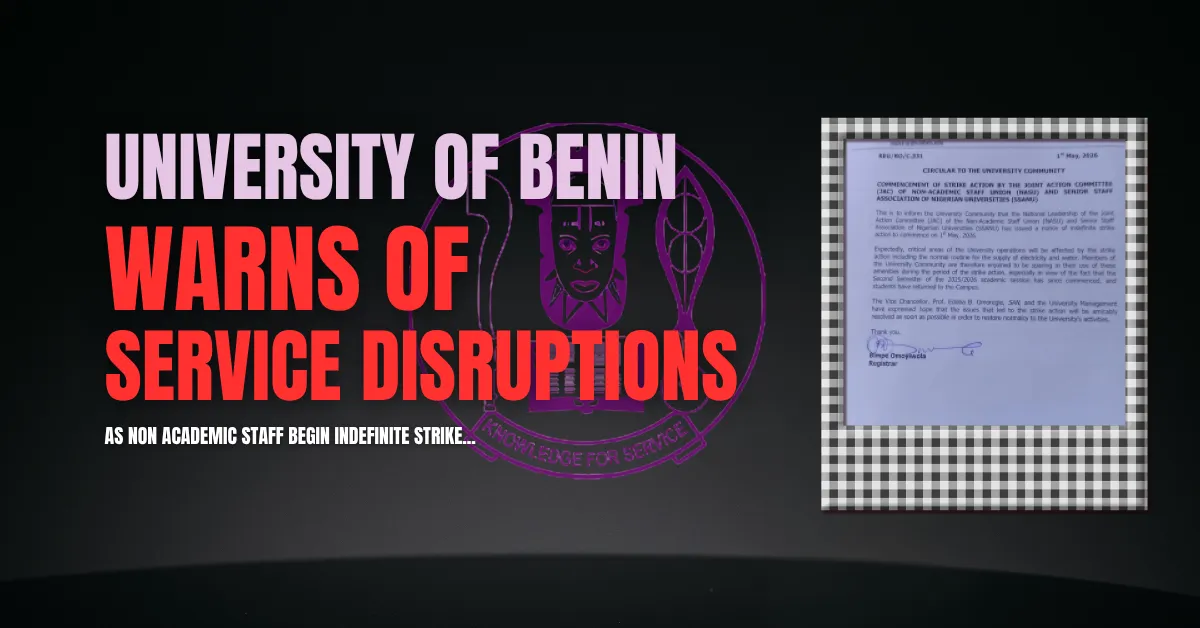
Students and staff at the University of Benin are facing disruptions to essential services after the Joint Action Committee of the Non Academic Staff Union and the Senior Staff Association of Nigerian Universities commenced an indefinite strike on May 1, 2026, with electricity and water supply among the services at risk.
The university's Registrar, Bimpe Omoyiwola, communicated the development through an official circular issued on May 1, 2026, informing the institution's community that the national leadership of the Joint Action Committee had directed members nationwide to begin the industrial action with immediate effect.
The circular stated: "This is to inform the University Community that the National Leadership of the Joint Action Committee of the Non Academic Staff Union and Senior Staff Association of Nigerian Universities has issued a notice of indefinite strike action to commence on 1st May, 2026."
Management warned that services relating to electricity supply, water distribution and other essential administrative and support functions could experience significant interruptions. The notice urged members of the university community to exercise restraint in their use of available amenities, adding that "members of the University Community are therefore enjoined to be sparing in their use of these amenities during the period of the strike action."
The university noted that the warning was particularly urgent given that the second semester of the 2025/2026 academic session had already commenced, with students present on campus for academic activities.
Vice Chancellor Prof. Edoba B. Omoregie and the institution's management team expressed confidence that ongoing negotiations between the unions and relevant authorities would produce a swift resolution. Management stated its hope that the issues responsible for the industrial action would be resolved amicably to restore normal academic and administrative activities.
The circular did not detail the specific grievances driving the strike, though the action adds to a pattern of labour disputes that have continued to strain Nigeria's public university system.


Leave a Reply