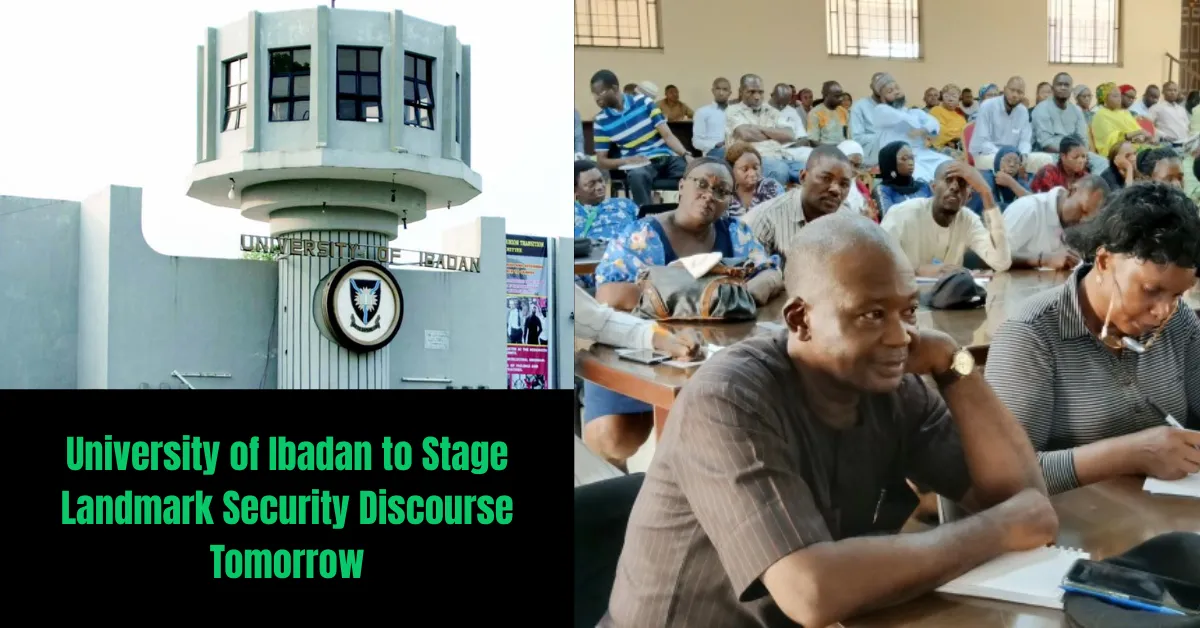
The University of Ibadan (UI) is tomorrow, 25th March, 2026, opening the doors of its Senior Staff Club for what promises to be one of the most consequential diplomatic conversations on Nigeria's security crisis in recent times. The event is built on a clear conviction that the battles tearing at Nigeria's stability cannot be won by firepower alone.
The discourse carries a striking title: "Security in Nigeria: Where we are coming from, Where we are, Where we want to be." It arrives on the heels of a widely praised February edition that tackled the explosive intersection of Artificial Intelligence and the 2027 Elections, and expectations are already running high.
Organisers have pulled together a panel of some of Nigeria's sharpest minds, each bringing a distinct discipline to bear on a crisis that has defied simple solutions. The goal is clear: to map a credible, well reasoned road to national stability.
At the front of that conversation will be Prof. Isaac Albert, a heavyweight in African History, Peace and Conflict Studies. He pioneered the Faculty of Multidisciplinary Studies at UI and once sat as a federal delegate at Nigeria's landmark 2014 National Conference.
Albert's credentials stretch beyond Nigeria's borders. Trained at the United Nations International Leadership Academy, he is expected to conduct a surgical historical examination of how Nigeria's security situation evolved and where the fault lines of tomorrow are already forming.
Holding the panel together as moderator is Prof. Olanrewaju Olaniyan, the Vice Chancellor of Emmanuel Alayande University of Education in Oyo. His grounding in Population Economics brings a rarely explored angle on how Nigeria's demographic pressures and age structure quietly fuel instability and economic fragility.
Completing the panel is Prof. Nelson Fashina of UI's Department of English, a Fulbright Scholar and traditional high chief. Fashina is set to unpack the deeper cultural codes, language, identity and social narrative that quietly stoke conflict and erode cohesion in Nigerian society. His voice on the panel ensures the academic debate stays rooted in lived, grassroots reality.

Leave a Reply