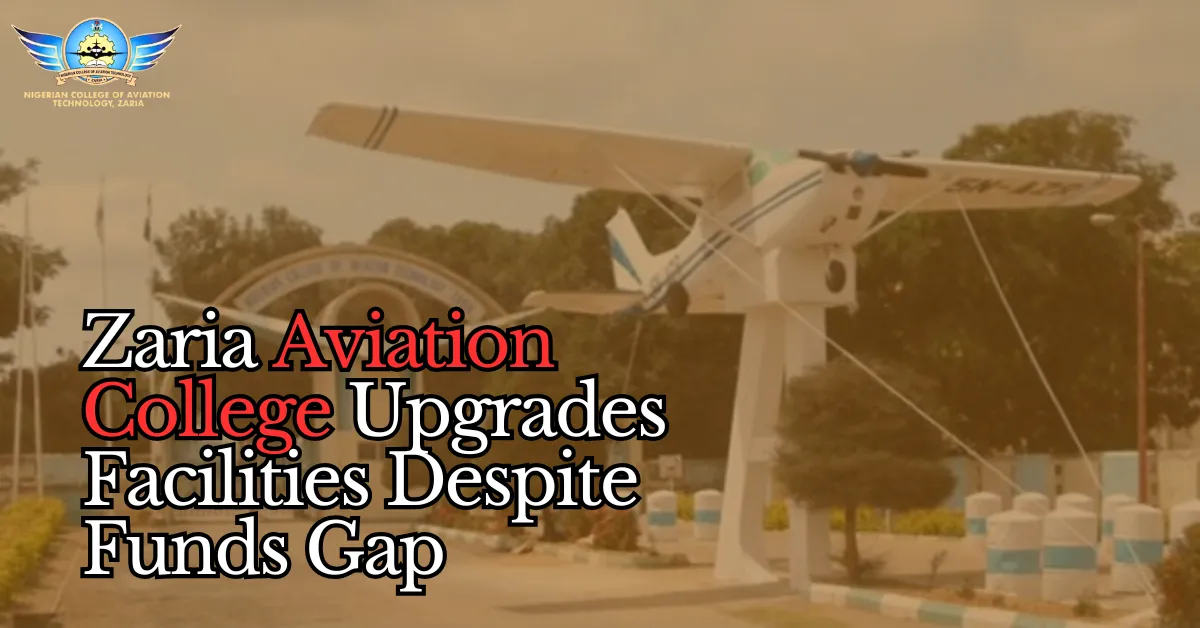
The Nigerian College of Aviation Technology, Zaria, has upgraded critical infrastructure, secured key international accreditations and expanded its training capacity despite persistent funding challenges.
The Rector, Danjuma Ismaila, disclosed this during a media briefing with journalists in his Zaria office at the weekend, according to a statement signed by the College's Media Consultant/Adviser, Obinna Nwachukwu, on Monday. He noted that NCAT remains Nigeria's only Institution offering comprehensive aviation training, with over 200 courses covering pilot training, air traffic control, aircraft engineering and other aviation related disciplines.
Ismaila stated, "We inherited a system that required significant reforms and upgrades. Since coming on board, we have focused on improving our infrastructure and strengthening our academic programmes to align with international best practices."
He revealed that the rehabilitation and upgrade of students' hostels, classrooms and other critical facilities ranked among the administration's major achievements. The College has also retained its Platinum Membership and Centre of Excellence status while securing accreditation from the United States based Aviation Accreditation Board International.
Ismaila disclosed that NCAT obtained membership of the National Council for Management Development and restored its affiliation with the International Air Transport Association, enabling it to run globally recognised IATA certified courses. He added that the College became a beneficiary of the Tertiary Education Trust Fund following its accreditation by the National Board for Technical Education.
The Rector revealed that the College was working towards European Union Aviation Safety Agency certification, which would grant its graduates dual certification for global employability, and disclosed that its Boeing 737 Next Generation full flight simulator, described as the only one of its kind in Nigeria, was close to certification for commercial operations.
Despite these achievements, Ismaila identified inadequate funding as one of the College's biggest challenges, noting that one of its TBM training aircraft is currently grounded due to insufficient maintenance funds. He lamented that NCAT currently admits only about 25 pilot trainees every six months on a first come, first served basis. "We can only admit about 25 pilot trainees every six months, which is inadequate for a country of over 200 million people. The demand is overwhelming," he said.
Ismaila expressed optimism that sustained government support would consolidate NCAT's position as West Africa's leading aviation training Institution.



Leave a Reply