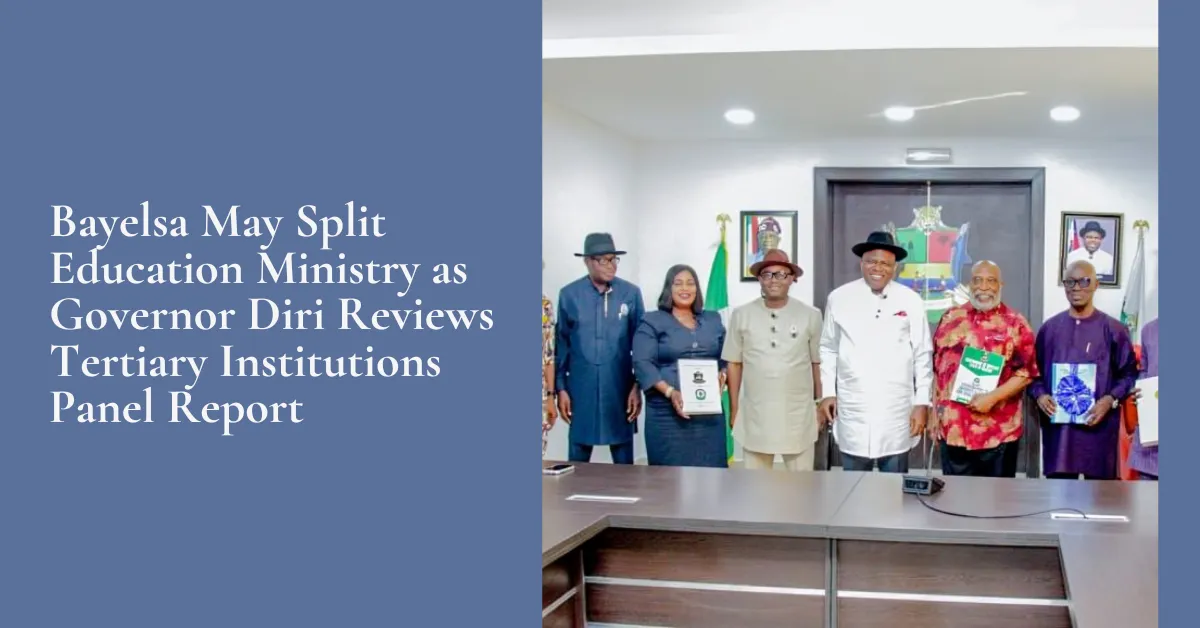
Bayelsa State may soon have a dedicated Ministry of Higher Education, after Governor Douye Diri indicated his willingness to consider the proposal following recommendations from a state appointed visitation panel on tertiary Institutions.
The panel, chaired by Oyovwin Osusu, presented its findings at the Government House in Yenagoa, arguing that the growing number of tertiary Institutions in Bayelsa had made it impractical to leave higher education oversight entirely within the existing Ministry of Education. A standalone ministry, the panel argued, would allow for more focused policy development, better governance structures, and improved institutional administration across the state's higher education system.
Among the panel's other recommendations was a rotational allocation of Tertiary Education Trust Fund disbursements between Bayelsa Medical University and the University of Africa, Toru Orua, to ensure both institutions have equitable access to federal intervention resources. Governor Diri acknowledged the recommendation but noted that implementing it may require legal adjustments to the establishment laws governing some institutions, suggesting that amending existing frameworks might be a more effective route than rotation.
The governor described the panel's work as "germane and important" and used the occasion to highlight progress made under his administration, including the achievement of full programme accreditation at several state Institutions. He cited the Isaac Jasper Boro College of Education, Sagbama, which previously lacked accreditation but now meets the standards required for graduates to pursue further academic qualifications. Diri is also committed to establishing functional governing boards for all state owned institutions and to continuing infrastructure investment across the tertiary education sector.
For students enrolled in Bayelsa's public Tertiary Institutions, the proposed ministry would represent a structural shift in how decisions affecting their institutions are made, potentially reducing the administrative delays and policy gaps that arise when higher education competes for attention within a broader ministry mandate.



Leave a Reply