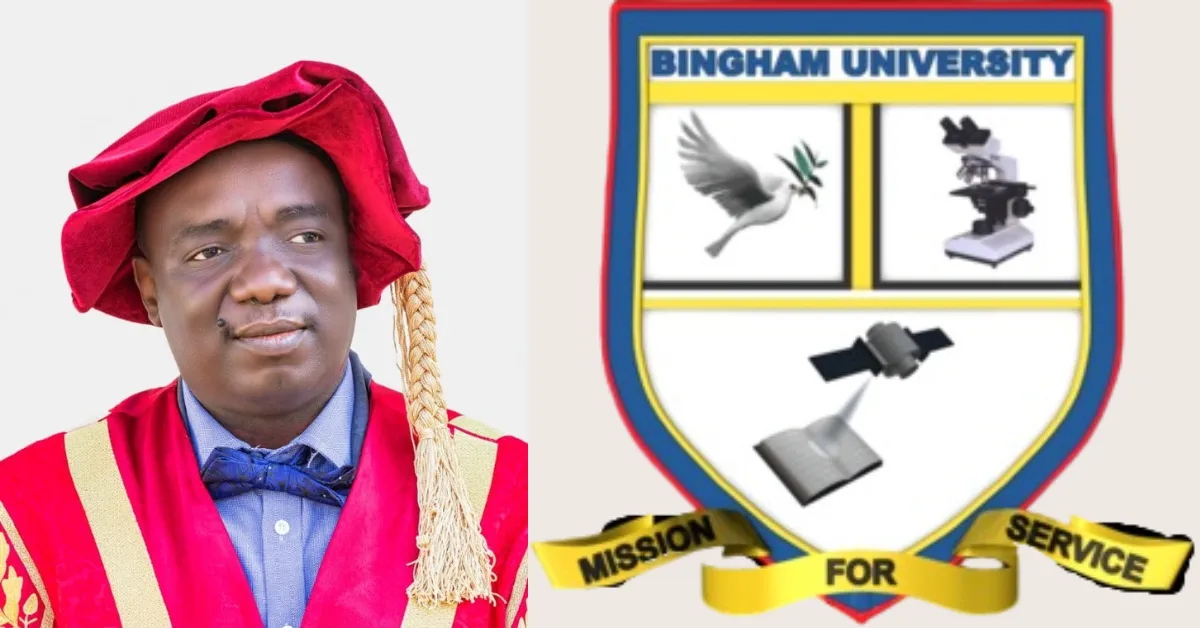
Professor Haruna Ayuba, Vice Chancellor of Bingham University in Karu, Nasarawa State, has praised a former Provost of the College of Medical Sciences and current Deputy Vice Chancellor, Prof. Musa Dankyau, for his outstanding contributions to academia, medicine, and university administration.
The VC gave the commendation during Prof. Dankyau's 11th inaugural lecture at the university campus in Karu, Nasarawa State.
Prof. Ayuba described the inaugural lecturer, Professor Dankyau, as "a man of many parts" whose career has been marked by dedication and effective leadership.
“As my Deputy Vice Chancellor for about two years now, he demonstrates exceptional administrative acumen as he chairs numerous university committees and contributes to strategic decision-making processes,” Ayuba said.
The Vice Chancellor stated that Prof. Dankyau's lecture, "The Protean Nature of Family Medicine and Family Care: Old Medicine for New Problems", was both timely and intellectually stimulating.
Ayuba emphasised the theme's significance by explaining that the concept of "protean" is derived from the Greek mythology character Proteus, who is known for his ability to change form.
The vice chancellor went on to say, "In the context of today's lecture, we could assume that family medicine is like Proteus because it is a flexible and adaptable field that can address a wide range of health issues while evolving to meet new challenges.
“It is the cornerstone that provides comprehensive, continuous, and patient-centred care.”
Prof. Ayuba emphasised that the lecture connects the past, present, and future of medical practice, demonstrating the enduring relevance of fundamental medical principles in the face of rapid technological and societal change.
The vice chancellor congratulated Prof. Dankyau on becoming the university's 11th inaugural lecturer and announced that the College of Medical Sciences currently has four inaugural professors.
The Faculty of Social Sciences has three inaugural lecturers, followed by the Faculties of Administration and Science & Technology, both of which have two.
“Other faculties that are yet to present their professors for inaugural lectures need to step up on this cherished academic tradition,” Ayuba urged.
He also disclosed plans by the university to compile its first ten inaugural lectures into a Volume One publication to serve as a resource for postgraduate students and scholars.
“By the grace of God, we hope to compile the first ten inaugural lectures as Volume One so that all postgraduate students and interested scholars can benefit from the rich tapestry of knowledge in the collection,” he said.
The Vice Chancellor thanked the Inaugural Lecture Committee for organising the event and praised the inaugural lecturer's wife for her unwavering support.
Prof. Dankyau contested the notion that family medicine was an outmoded branch of healthcare struggling to remain relevant.
Instead, he described it as the most adaptable and resilient system response to today's complex, interconnected health crises.
“Family medicine", he argued, “is not yesterday’s medicine fading into irrelevance. It is an enduring system of wisdom,” he added.

Leave a Reply