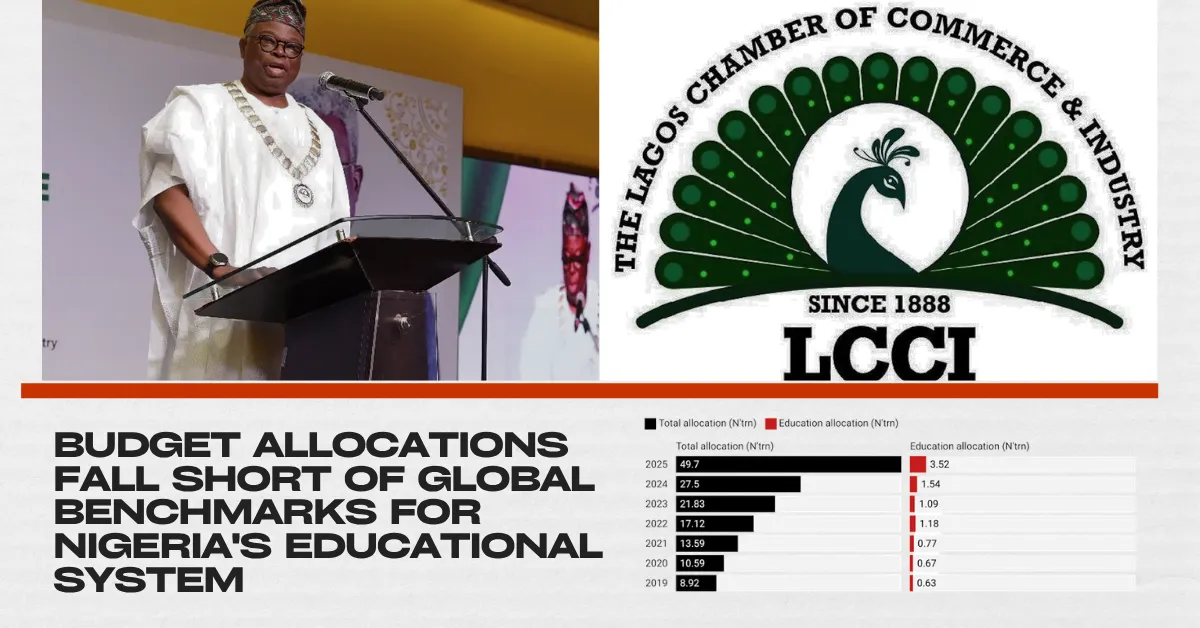
A major structural crisis has hit the domestic learning sector as current federal funding levels fell massively below international development standards. Lagos Chamber of Commerce and Industry President, Mr Leye Kupoluyi disclosed the deep systemic crisis on Thursday during the annual educational assembly in Lagos. The chamber leadership noted that the ongoing deficit across funding, technology, and policy implementation directly threatens the future productivity of the national workforce.
Financial breakdowns from the active fiscal period revealed a significant gap between official policy goals and actual cash distribution. The chamber president stated that the 2026 federal budget dedicated only 3.52 trillion Naira to the learning sector. This allocation represents just 6.1% of the total 58.18 trillion Naira national expenditure package. This current funding level contradicts the 26% threshold established in Nigeria's National Policy on Education and misses the 15% to 20% global benchmark recommended by UNESCO.
Commercial operators noted that regional administrations with strong political will are already proving that standard educational targets remain highly achievable within the country. The chamber disclosed that Enugu State allocated 32.2% of its entire 2026 budget to classroom development. Similarly, Kano State committed 405.3 billion Naira representing 30% of its resources, while Jigawa State dedicated 234.5 billion Naira to reach the 26% mark. Corporate employers revealed that these sub national models must be expanded immediately to absorb millions of vulnerable citizens into the active economic pipeline.
Demographic data indicates that the country currently hosts a massive portion of the global out of school population. The organization stated that roughly one in five of the world's unschooled children resides within the federation territories. Administrative records from UNICEF placed the total domestic figure at 18.3 million children, including 10.2 million individuals at the primary school level and 8.1 million candidates at the secondary level.
Industrial updates showed that internet infrastructure expansion remains highly unequal across various geographic zones. The agency announced that national broadband penetration reached 50.58% in November 2025, rising from 44.43% in the previous year. Group representatives revealed that the remaining half of the country lacks the basic connectivity required to operate a digital classroom, with the deficit heavily concentrated in rural northern households. The management confirmed that the Nigerian Education Loan Fund has disbursed 32 billion Naira to beneficiaries since 2024 to cushion these deep financial shocks.


Leave a Reply