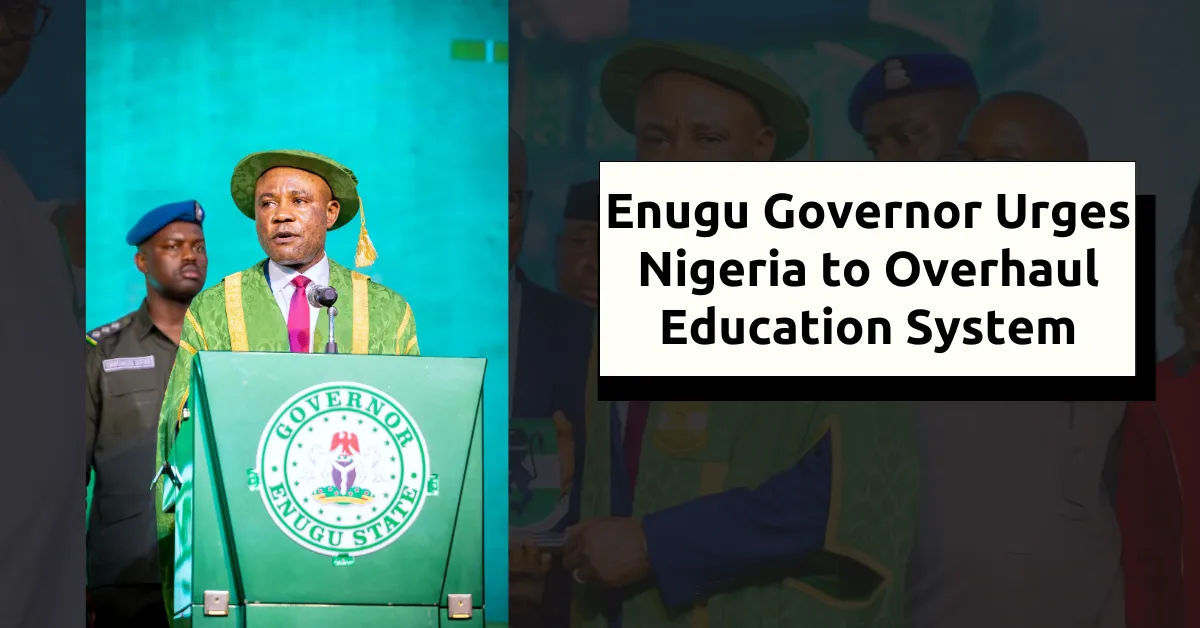
Enugu State Governor Dr. Peter Mbah has called for a fundamental restructuring of Nigeria's education system, arguing that schools must prioritise producing problem solvers and innovators over graduates who hold certificates without the capacity to apply knowledge productively.
Mbah made the call on Thursday, July 24, while delivering the 55th Convocation Lecture of the University of Nigeria, Nsukka. The lecture, titled "Restoring the Dignity of Man: Enugu's Quantum Leap in Human Development and Inclusive Prosperity Through Experiential Learning," framed education as the primary vehicle for restoring human dignity in the age of artificial intelligence, biotechnology and the knowledge economy.
"True dignity exists when people possess not merely the freedom to aspire, but the capability to transform aspiration into achievement, potential into productivity, and possibility into shared prosperity," he stated.
The governor traced Enugu's education reforms to the Igbo apprenticeship model, which he described as embodying learning by doing, mentorship, trust, discipline and entrepreneurship. He positioned experiential learning not as an imported concept but as a modern expression of indigenous knowledge tradition.
"Our purpose is not to romanticise the past, but to apply its deepest principle to the future. This is why we embraced experiential learning, not as a foreign educational idea, but as a modern expression of our knowledge tradition and a twenty first century development imperative," Mbah said.
He disclosed that the Centre for Experiential Learning and Innovation is driving curriculum reform, teacher training, digital literacy and industry partnerships to close what he described as the activation gap between knowledge and opportunity. Approximately one third of Enugu's annual budget has been directed to education, funding the construction of 268 Smart Green Schools across the state's 260 political wards. More than 23,000 teachers have received digital literacy training, while 4,698 additional teachers have been approved for recruitment.
Mbah announced plans to establish three specialised universities focused on Artificial Intelligence and Technology, Education and Technology, and Agriculture, Agro industrialisation and Technology. New degree programmes in Automation, Artificial Intelligence and Mechatronics have already been introduced at ESUT and IMT.
He cited the story of Arinze Edeoga, a pupil from the rural Owo community, who taught digital literacy to urban peers as evidence of experiential learning's transformative reach.
"A village child became a teacher of urban peers. In Arinze, you see restored confidence, democratized opportunity, and a child once defined by geography becoming a creator of knowledge rather than merely a consumer of it. You see the dignity of man," the governor said.
Vice Chancellor Prof. Simon Ortuanya and event chairman Prof. Chinedu Nebo both commended Mbah's record in human capital development, noting the breadth of his administration's sectoral impact within three years.

Leave a Reply