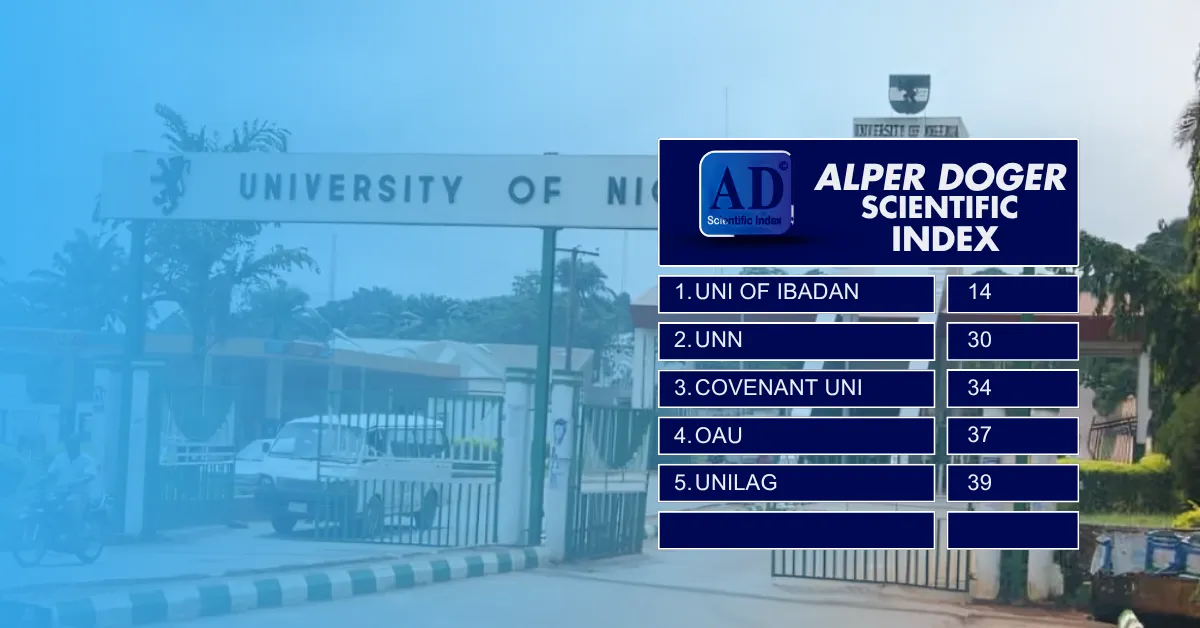
For a University that has spent decades building its research credentials largely without the International visibility its output deserves, the 2026 Alper Doger Scientific Index has delivered a significant moment of recognition, placing the University of Nigeria, Nsukka, second among all Nigerian Universities assessed in the ranking.
The AD Scientific Index evaluates Universities and individual scholars worldwide based on research productivity and impact, drawing on metrics such as the H index, i10 index, and citation counts from Google Scholar data. In the latest edition, 317 Nigerian Universities were assessed out of 19,336 institutions globally. UNN placed second nationally, 1,197th in the world, and 30th across Africa.
The result is consistent with a broader upward trend for the Institution. The QS World University Rankings have placed UNN among the top 20 Universities in Africa, and Professor Obinna Onwujekwe, a scholar at the University, was recently recognised in the Talent 100 global ranking for his contributions to evidence based health policy, health systems strengthening, and public health.
Vice Chancellor Professor Simon Uchenna Ortuanya welcomed the development but declined to treat it as cause for complacency. "We are encouraged by the recent ranking by the AD Scientific Index. However, we will not rest on our oars until the University of Nigeria is ranked the best in Africa by major global ranking agencies," he said, adding that his administration would maintain its focus on raising both academic and infrastructural standards across the campus.
Second place in Nigeria is a result that deserves recognition, but what it signals about UNN's longer term ambitions may matter more. With a Vice Chancellor who has set Africa's top spot as the explicit target and a research profile that is drawing global attention, the question is no longer whether UNN belongs among the continent's leading universities. It is how quickly it intends to prove it.



Leave a Reply