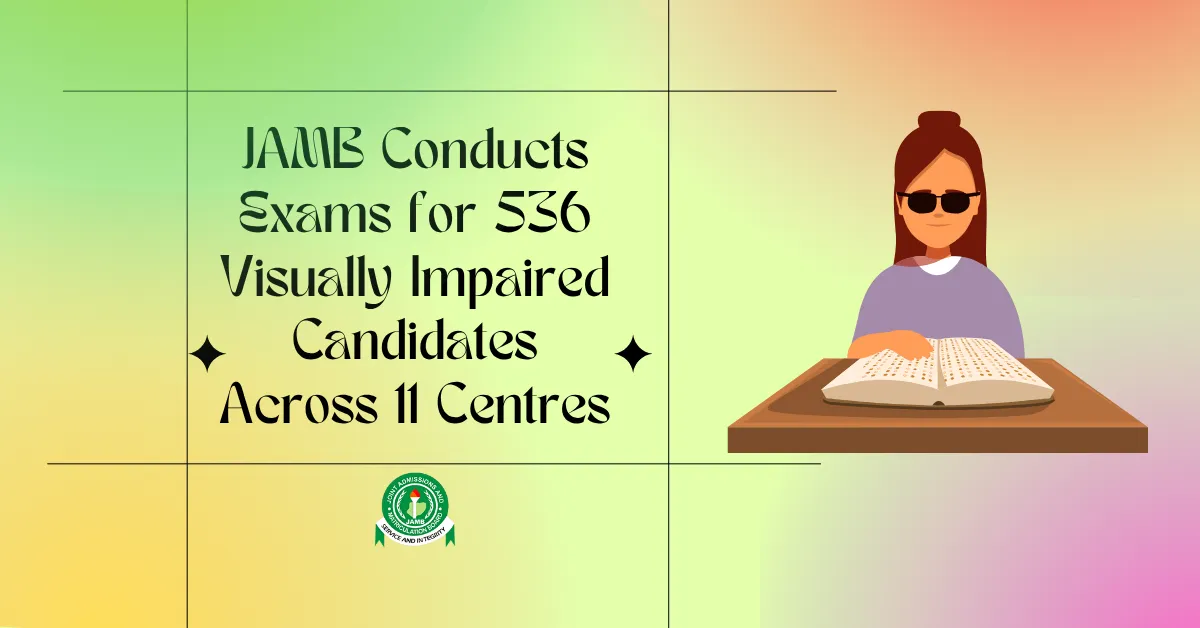
The Joint Admissions and Matriculation Board has drawn praise for its handling of candidates with disabilities in the 2026 Unified Tertiary Matriculation Examination, with Emeritus Professor Peter Okebukola describing the board's inclusion framework as a model for the rest of Africa.
Okebukola, who chairs the JAMB Equal Opportunity Group and serves as President of the Global University Network for Innovation, addressed journalists on Monday at the opening of special examination sessions, where 536 candidates with visual impairments and other special needs began writing the examination across 11 centres nationwide.
Kano led all centres with 136 candidates, followed by Lagos with 95 and Abuja with 46. Centres in Ado Ekiti, Bauchi, Benin City, Enugu, Kebbi, Oyo, Jos, and Yola also hosted candidates, with sessions supervised by seasoned academics, several of whom are former vice chancellors.
Each candidate and their guide received free accommodation, feeding, and transportation, consistent with support arrangements that the JAMB Equal Opportunity Group has maintained since 2017. Customised examination materials were also provided, with candidates offered a choice between Fully Braille and Fully Read Aloud formats under a bimodal examination system now in its third consecutive year.
Admission figures from the 2025 cycle underlined the programme's growing impact. Of 483 candidates with disabilities who applied for tertiary placement, 252 were admitted, a success rate of 52.2%.
"Candidates with visual impairment formed the largest group, accounting for 429 applications, with over half successfully admitted. Other categories, including candidates with Down Syndrome, Autism Spectrum Disorder, and Dyslexia, also recorded notable admission rates, with Dyslexia candidates achieving a 100% success rate," Okebukola stated.
He acknowledged that blind students continue to face barriers in science related disciplines and confirmed that targeted efforts to address those challenges have been ongoing since 2018. Okebukola also welcomed a visible increase in interest among candidates with disabilities in science, technology, engineering, and mathematics, describing the trend as a positive development for inclusive education in Nigeria.



Leave a Reply