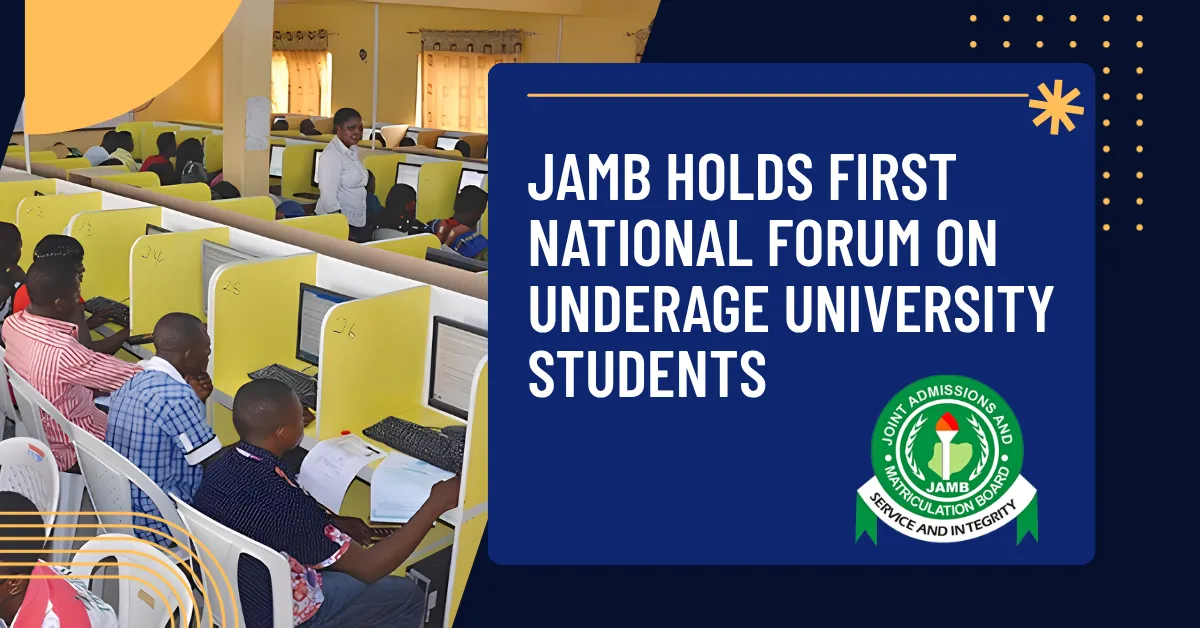
Nigeria's education stakeholders have praised the Joint Admissions and Matriculation Board for organising what has been described as the country's first national engagement dedicated entirely to underage students admitted into tertiary institutions, with experts calling the initiative unprecedented in global higher education administration.
The forum, held on Tuesday in Abuja, was organised by the JAMB Equal Opportunity Group and drew 283 participants under the theme, "Achieving Success in Higher Education of Underage Students Admitted in the 2025/2026 Session." Those in attendance included vice chancellors, parents, education experts, child development specialists, legal practitioners and the underage students themselves.
At the centre of the commendations was JAMB Registrar, Professor Ishaq Oloyede, who convened the engagement. Professor Emeritus Peter Okebukola, President of the Global University for Innovation, told journalists at the end of the event that no higher education system anywhere in the world had established a coordinated national support structure for gifted underage students comparable to what Oloyede had introduced.
The forum revealed that 96 students below the statutory minimum admission age of 16 were accepted into Nigerian universities for the 2025/2026 academic session following a rigorous multi layered screening process approved by the Federal Ministry of Education. To qualify, each candidate was required to score a minimum of 320 in the Unified Tertiary Matriculation Examination, obtain at least 80 per cent in post UTME examinations, score at least 80 per cent in the Senior School Certificate Examination, and attain 80 per cent in an independent expert assessment interview.
Oloyede stressed that the admissions were "neither accidental nor sentimental," tracing the government's position on admission age to the 1981 National Policy on Education.
"As far back as the 1981 National Policy on Education, Nigeria had already established a structured educational progression designed to align learning with stages of cognitive and emotional development. This policy direction has remained substantially consistent over the years because educational progression is not merely about academic exposure, but about the total preparation of the learner for life and society," Oloyede stated.
He added that institutions, including the University of Ibadan and Lagos State University, strictly uphold the minimum age requirement regardless of academic brilliance.
Okebukola, who chairs JEOG, disclosed that mentors had been individually assigned to each of the 96 students, with institutions, parents and counsellors all assigned defined roles in supporting their development.
"Our task today is to ensure that precocity is met not with neglect or indifference, but with wisdom, structure and genuine love for the young," Okebukola noted.
The engagement featured three technical sessions covering pedagogy for gifted learners, psychological support and legal frameworks guiding child protection, including provisions of Nigeria's Child Rights Act.



Leave a Reply