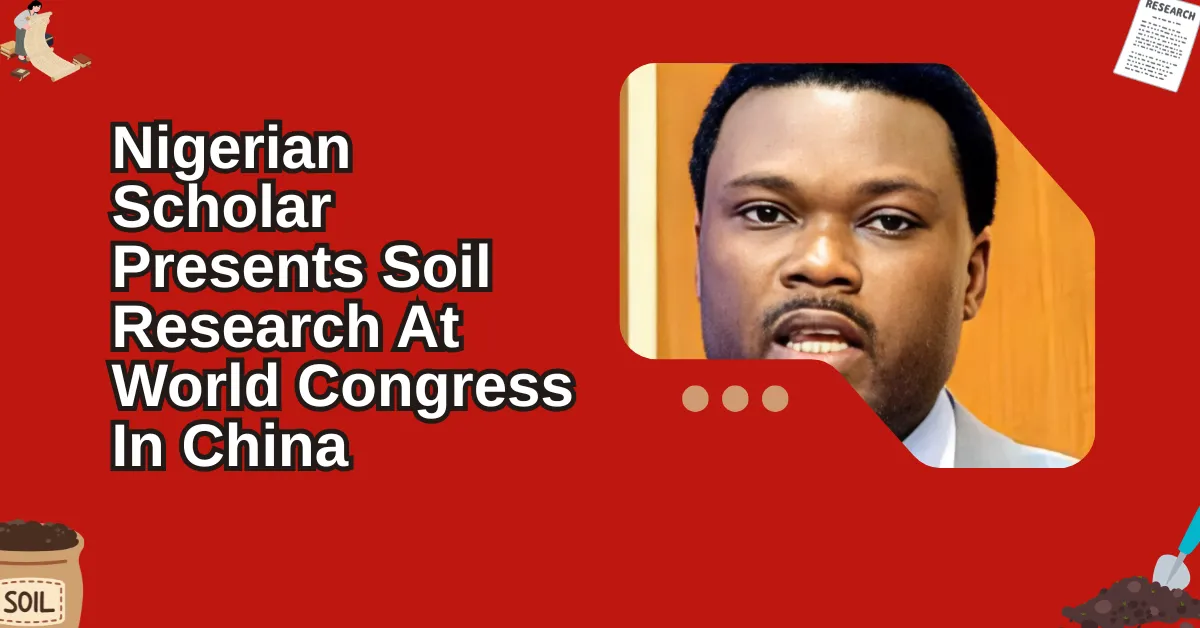
A Nigerian doctoral researcher, Oluwasegun John Olubisi, has presented his work on cover crop systems and soil nutrient dynamics at the 23rd World Congress of Soil Science, one of the largest and most prestigious gatherings in the field of soil science worldwide.
Held from June 7 to 12, 2026, at the Nanjing International Expo Centre in Nanjing, China, under the theme "Soil and the Shared Future for Humanity," the congress was jointly organised by the International Union of Soil Sciences and the Soil Science Society of China. Convened every four years since 1927, the event drew research scientists, policymakers, industry representatives, and students from across the globe, with 121 scientific sessions spread across five categories.
Olubisi, a doctoral student in interdisciplinary ecology with a concentration in soil and water science at the University of Florida's School of Natural Resources and Environment, delivered a presentation titled "Enzyme Mediated Nutrient Dynamics in Cover Crop Systems: Temporal and Spatial Optimisation Strategies."
His research examines how soil enzymes regulate the release and cycling of nutrients in cropping systems that use cover crops such as sunn hemp and sorghum sudangrass, offering practical strategies for timing and positioning interventions that can improve soil fertility, reduce nutrient losses and support more sustainable farming.
Describing the congress as a rare opportunity to place African and globally relevant soil challenges before the international scientific community, Olubisi noted that sandy and tropical soils, which dominate much of Nigeria and the wider region, face particular pressures around fertility, carbon storage, and water retention, adding that science driven management offers a path toward more resilient agriculture.
His dissertation research, conducted at the Gulf Coast Research and Education Centre in Wimauma, Florida, investigates the combined effects of soil amendments and cover crops on sandy soil health, carbon sequestration, and nutrient dynamics, using bell pepper as a test crop, and is supported by a competitive Water Institute Water Scholars Graduate Fellowship.
Olubisi earned his master's degree at Obafemi Awolowo University, Ile Ife, and conducted part of that research at the Federal University of Rio Grande do Sul in Brazil, supported by an International Humic Substances Society Research Training Award. He previously served as a Junior Research Fellow at the Institute of Agricultural Research and Training in Nigeria, with prior work spanning biochar based slow release fertilisers, soil enzymes as bioindicators of soil health, and carbon sequestration in sandy and tropical soils.
Beyond presenting his findings, Olubisi used the congress to build research collaborations and engage with global discussions on climate smart agriculture and soil restoration, expressing optimism that the connections made in Nanjing would strengthen knowledge exchange between Nigerian institutions and the wider international soil science community.

Leave a Reply