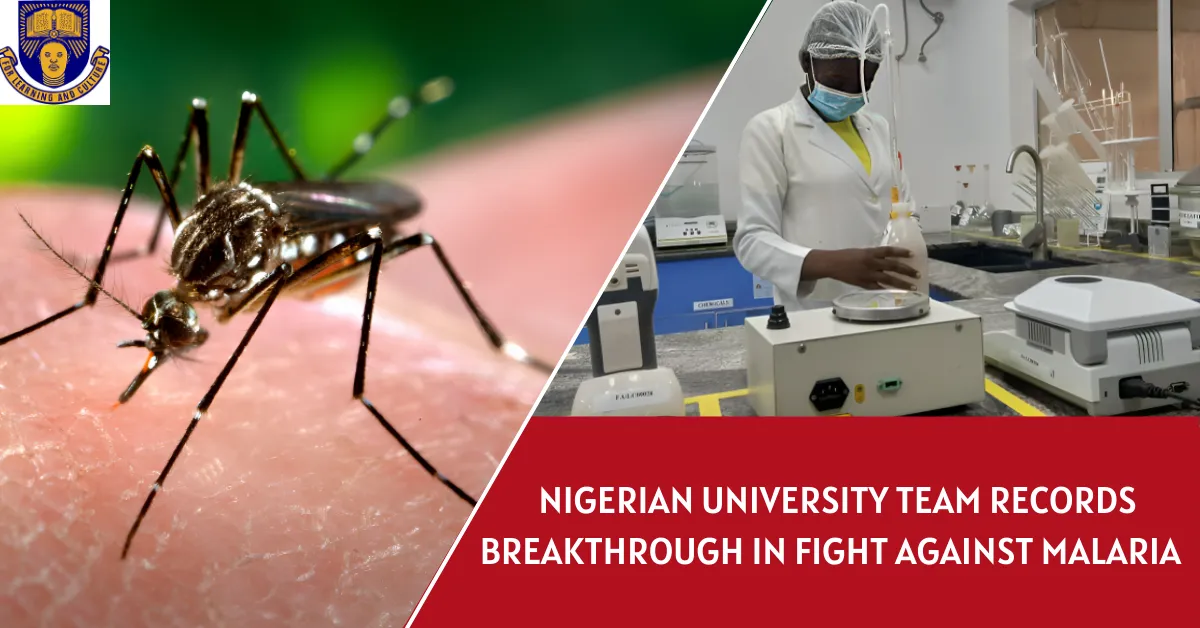
Scientists at Obafemi Awolowo University in Ile Ife, Osun State, have made a breakthrough that could help develop new malaria treatments.
Led by Dr. Olatomide Fadare, an Associate Professor of Chemistry at OAU, the team studied the structure of a key protein in the malaria parasite and shared their findings with researchers worldwide through the Protein Data Bank, a global database for important scientific data.
This marks the first time Nigerian scientists have independently contributed such detailed research to this international database, showing that Nigeria can compete with Western countries in advanced medical research.
Dr. Fadare explained in an interview with PUNCH Online on Monday that malaria parasites are becoming resistant to current drugs, making it urgent to develop new treatments.
"If we don't continue to design new therapies that target different pathways, the parasite will always catch up with us," Fadare stated.
The team collaborated with other Nigerian scientists based abroad, including Dr. Olawale Raimi in Scotland, Dr. Abiodun Ogunjimi in Canada, Professor Olubanke Ogunlana at Covenant University in Ogun State, and Dr. Oluseyi A. Vanderpuye in the United States.
The researchers studied transketolase, an enzyme that allows the malaria parasite survive and multiply inside the human body. For years, scientists worldwide struggled to study this enzyme properly because nobody had created a clear picture of its structure.
"We carried out protein engineering, produced the protein, and successfully crystallised it. Getting to the point where you can create a crystal from your protein is highly advanced science," Fadare explained, adding that most structures in the global database came from Western researchers, but now Nigerians have joined as contributors rather than just users.
The team has already discovered four to five chemical compounds that can stop the parasite's enzyme from working without harming similar enzymes in human bodies.
"We believe that if we inhibit this protein, the metabolic processes it controls in the parasite will slow down or stop completely. That means the parasite cannot grow or replicate, and eventually it dies," Fadare stated.
He explained that whilst humans have a similar enzyme, the difference between the human and parasite versions is large enough to enable drugs that target only the parasite.
The next step involves improving these compounds to make them even more effective and specific before they can be actual medicines.
Dr. Fadare stressed that Nigeria needs to invest more in science and technology to reduce dependence on imported medicines, noting that during COVID 19, none of the vaccines came from Africa.



Leave a Reply