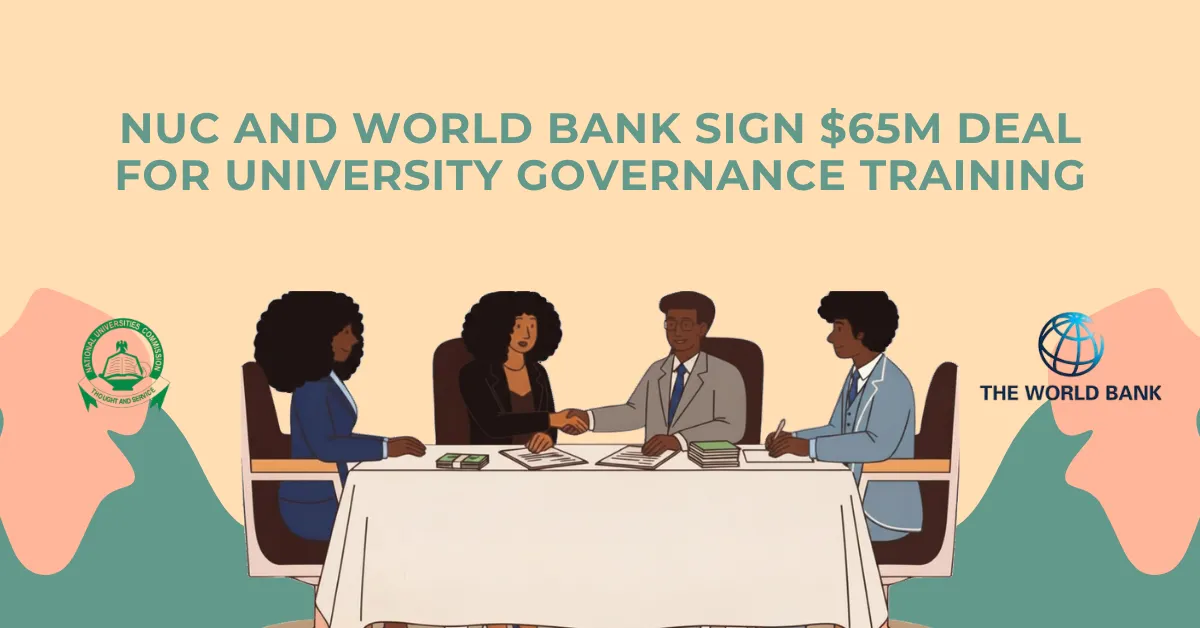
The National Universities Commission (NUC) and the World Bank have finalized a $65 million performance based agreement to expand university governance training throughout Nigeria. This strategic investment builds on the existing Sustainable Procurement, Environmental and Social Standards Enhancement (SPESSE) project, which aims to train Nigerian university professionals. The new phase has set a target to train an additional 24,000 individuals.
The signing ceremony took place on Wednesday in Abuja under the World Bank backed Sustainable Procurement, Environmental and Social Standards Enhancement Project, which launched in 2021 with an initial $80m facility and has since trained more than 40,000 people across six centres of excellence established in Nigerian universities.
The Executive Secretary of the NUC, Prof Abdullahi Ribadu, described the additional financing as a renewed opportunity to consolidate achievements and scale impact across participating institutions.
"This phase marks not only a continuation of the initiative, but also a renewed opportunity to consolidate achievements, scale impacts, and deepen sustainability measures across the participating institutions," Ribadu stated.
He confirmed that three of the six centres, including those at Ahmadu Bello University and Lagos State University, had already commenced PhD programmes, with the remaining three expected to begin in July 2026. Under the new phase, the project targets the production of at least 60 PhDs, enrollment of 60 foreign students, 18 staff internships and 60 student exchange programmes with foreign institutions.
Ribadu disclosed that The Gambia had already expressed interest in sending citizens to the centres, urging vice chancellors to take advantage of the opportunity.
The World Bank Task Team Leader for the SPESSE project, Ishtiak Siddique, confirmed that the additional financing became effective two weeks before the signing ceremony and described the project as central to governance reform across all sectors.
"If you want to do any development activities in the country, or any particular service from the government side you want to give to the citizen, you need to handle procurement, environment, and social sector," Siddique noted.
A key component of the new phase is the introduction of a full electronic procurement system at the federal level, with plans for later rollout to states. Siddique confirmed the system would incorporate machine learning and artificial intelligence to improve efficiency.
The Director General of the Bureau of Public Procurement, Adebowale Adedokun, disclosed that more than 2,700 officers drawn from federal, state and local government institutions had already been trained and certified under the project.
"In this additional financing stage, we will support the development and deployment of the government's electronic procurement system. It will also support online capacity building for small and medium scale enterprises, as well as all policymakers who are dealing with public funds," Adedokun added.
Leave a Reply