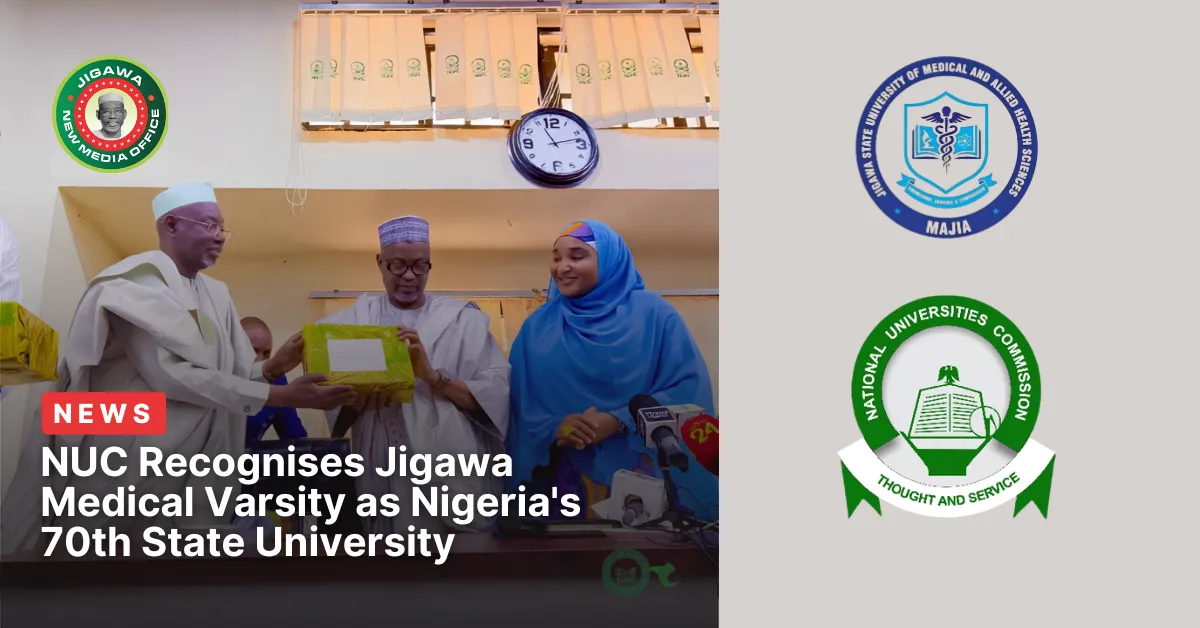
The National Universities Commission has recognised the Jigawa State University of Medical and Allied Sciences as Nigeria's 70th state owned university, with the institution also becoming the first in the country's history to result from a state government acquiring and converting an existing private university into a public institution.
The recognition ceremony was held in Abuja on Thursday, where NUC Executive Secretary Prof. Abdullahi Ribadu noted that the development would expand access to medical education and address a deepening healthcare workforce crisis. He stated that Nigeria's doctor to patient ratio remained critically below the World Health Organisation's recommended benchmark, a problem compounded by the emigration of medical professionals.
"There is no doubt that Nigeria faces a serious shortage of healthcare professionals. Our doctor to population ratio remains far below the World Health Organization's recommended benchmark. The situation is being compounded by the continued migration of medical personnel to other countries. So, in terms of the figures, if you see the doctor to population ratio, there may be issues. Some are one to 4,000, 3,500, and the figures that you see from the WHO are one to 4,000. So it's really a problem," Ribadu said.
The commission confirmed it would formally notify JAMB, TETFund, NYSC and NELFund of the university's new status, enabling its students to access government backed intervention programmes and education loans.
Ribadu disclosed that the institution would retain its existing non medical programmes until currently enrolled students complete their studies, after which those courses would be discontinued. From the 2027 academic session, subject to NUC resource verification, the university would introduce programmes in Anatomy, Physiology, Public Health, Nutrition and Dietetics, Radiography and Health Information Management. Nigeria now has 328 universities following recent provisional licence issuances.
Jigawa Governor, Umar Namadi, confirmed the state currently sponsors approximately 200 medical students abroad but established the institution to build local training capacity. "The students currently studying abroad will have to graduate first. After that, instead of sending students overseas, we will train them in our own university. We want to ensure that the doctors produced by the university meet international best practices," he said.
The Minister of State for Education, Prof. Suwaiba Ahmad, described the recognition as a major step in advancing President Bola Tinubu's Renewed Hope Agenda on healthcare and education, urging the institution to prioritise research and community service.

Leave a Reply