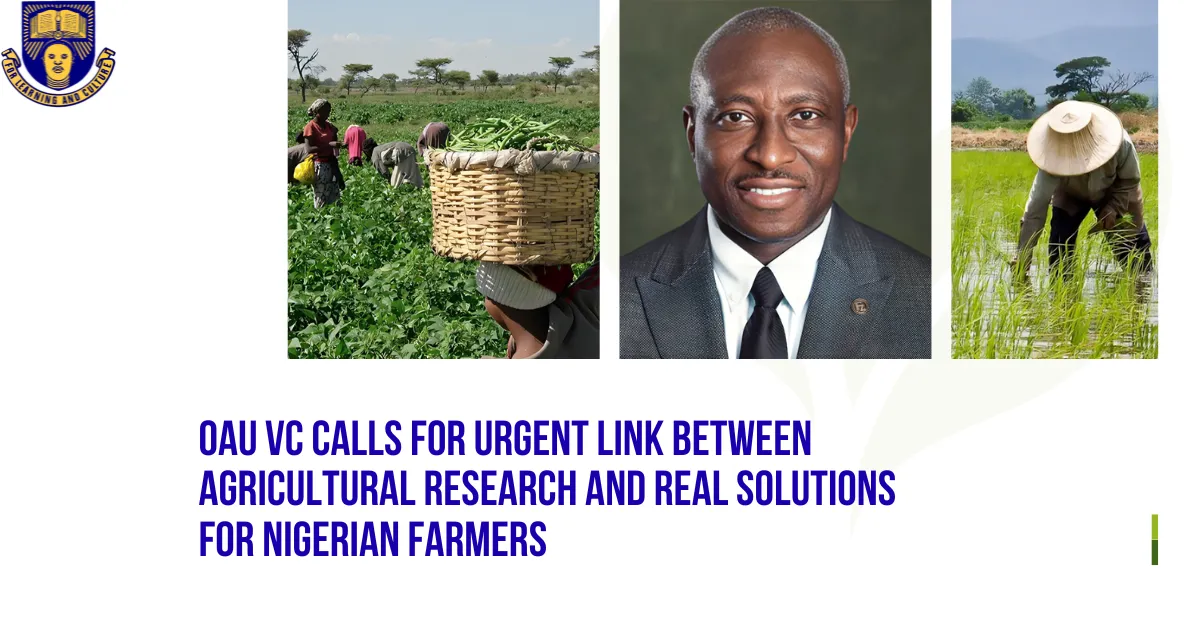
The Vice Chancellor of Obafemi Awolowo University has issued a direct challenge to Nigerian Agricultural Research Institutions, warning that findings gathering dust on shelves while farmers struggle with outdated tools represent a failure of the entire research enterprise.
Professor Simeon Bamire made the remarks at the 2026 in house review programme of the Institute of Agricultural Research and Training (IAR&T) in Ibadan, held under the theme "Cultivating Resilience: Research For Development In A Changing World."
Bamire argued that modern agriculture could no longer operate in isolation from other disciplines. "We must encourage research teams that cut across disciplines and institutions, because the problems we face today are too complex to be solved within narrow academic boundaries," he said. He called for stronger linkages between research institutes, Universities, the private sector, and Government Agencies to drive innovations from the laboratory to the field, specifically citing mechanisation, smart agriculture, precision farming, improved seedlings, and digital extension services as priorities.
On funding, the Vice Chancellor was unambiguous. "Sustainable agricultural development cannot be achieved without consistent investment in research infrastructure, laboratories, field facilities and human capacity development," he said, urging collaboration between government, private sector bodies, development partners and philanthropic organisations.
The funding crisis was given sharper focus by IAR&T Director Professor Gabriel Oluwatosin, who disclosed that the year under review recorded zero release of funds for capital projects. He told attendees that whatever research the institute managed to conduct was achieved through external funding from TETFUND and the personal financial contributions of scientists who proceeded with approved projects at their own expense while awaiting government disbursements.
"They did not fold their arms. They proved that while money is a tool, the real engine of the Institute remains the intellectual capital of the researchers," Oluwatosin said, describing his scientists' commitment as remarkable given the circumstances.
Oluwatosin also called on all three tiers of government to intervene meaningfully on agricultural challenges within their immediate environments, arguing that a holistic approach across federal, state, and local levels is essential for lasting solutions.



Leave a Reply