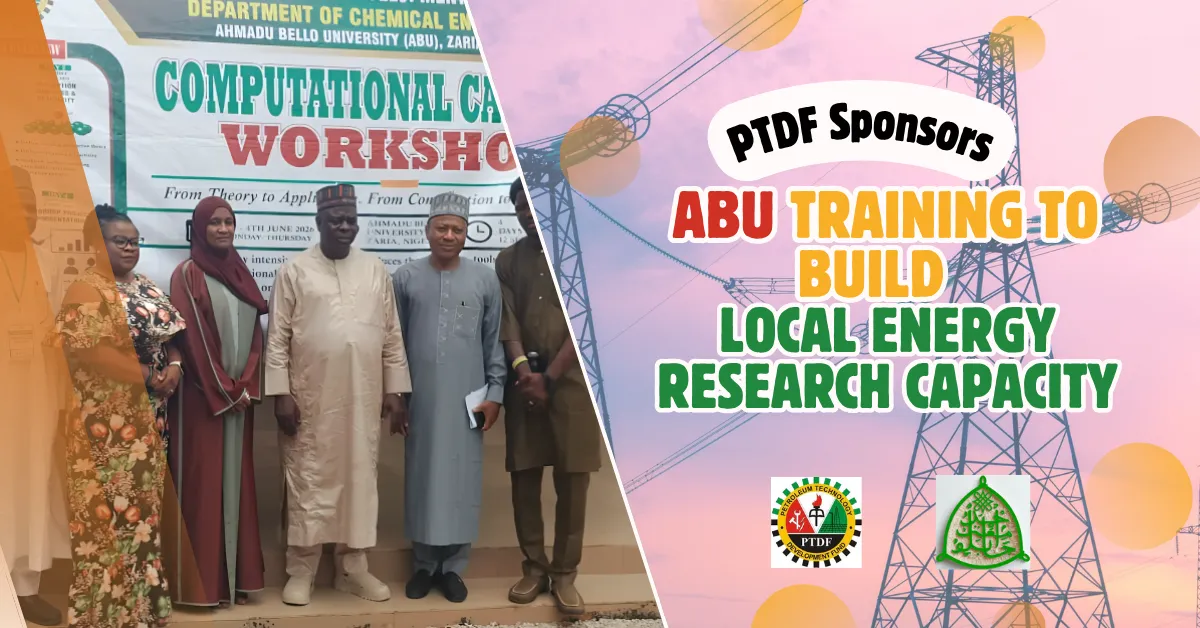
Nigeria's continued reliance on foreign specialists for catalyst design, process modelling and computational optimisation has drawn sharp criticism from the Vice Chancellor of Ahmadu Bello University, Zaria, Prof. Adamu Ahmed, who said the country's technological sovereignty depends on building indigenous expertise.
Ahmed made the remarks at the opening of a Petroleum Technology Development Fund sponsored training on computational catalysis held at the University, bringing together 35 researchers drawn from across Nigeria and one participant from the Republic of Chad.
Represented by the Deputy Vice Chancellor for Administration, Prof. Bello Sabo, Ahmed acknowledged Nigeria's position as Africa's largest oil-producing nation but noted the paradox of its continued dependence on foreign technical input.
"Nigeria is the largest oil producing nation on the continent. Yet, we remain dependent on foreign technical expertise for catalyst design, process modelling and computational optimisation. This is not a statement of failure; it is an opportunity," he stated.
He described ABU as a national institution built on the conviction that indigenous knowledge and homegrown expertise form the foundation of a truly sovereign nation, adding that the workshop represented "a deliberate investment in Nigeria's capacity to understand, design and optimise the catalytic systems that underpin our petroleum industry, petrochemical sector and emerging clean energy ambitions."
PTDF Executive Secretary Prof. Shu'aibu Shehu Aliyu, represented by General Manager for Education and Training Rabi Waziri, described computational catalysis as critical to advancing research and innovation in Nigeria's energy sector. He reaffirmed the fund's commitment to reducing foreign dependence and accelerating technological development.
"Computational catalysis improves efficiency and accelerates innovation. This workshop is designed to drive industrial growth and development by empowering researchers with the tools needed to solve real-world challenges," Shehu Aliyu stated.
The PTDF Chair Professor in Chemical Engineering at ABU, Prof. Abdulazeez Yusuf Atta, explained that computational catalysis allows researchers to predict chemical reactions and identify optimal pathways before entering the laboratory, cutting costs and improving efficiency.
"It guides you to a more specific area before you go into the lab. So, it saves cost, time and energy for a country like Nigeria," he noted, adding that participants would return to their institutions and cascade the knowledge as trainers of trainers.
Yusuf Atta disclosed that the PTDF had established a Professorial Chair Programme at ABU and five other universities nationwide to address critical industry challenges and support national development.
Africa's biggest oil producer still imports technical expertise for its own petroleum sector. ABU and PTDF just launched a programme to fix that.


Leave a Reply