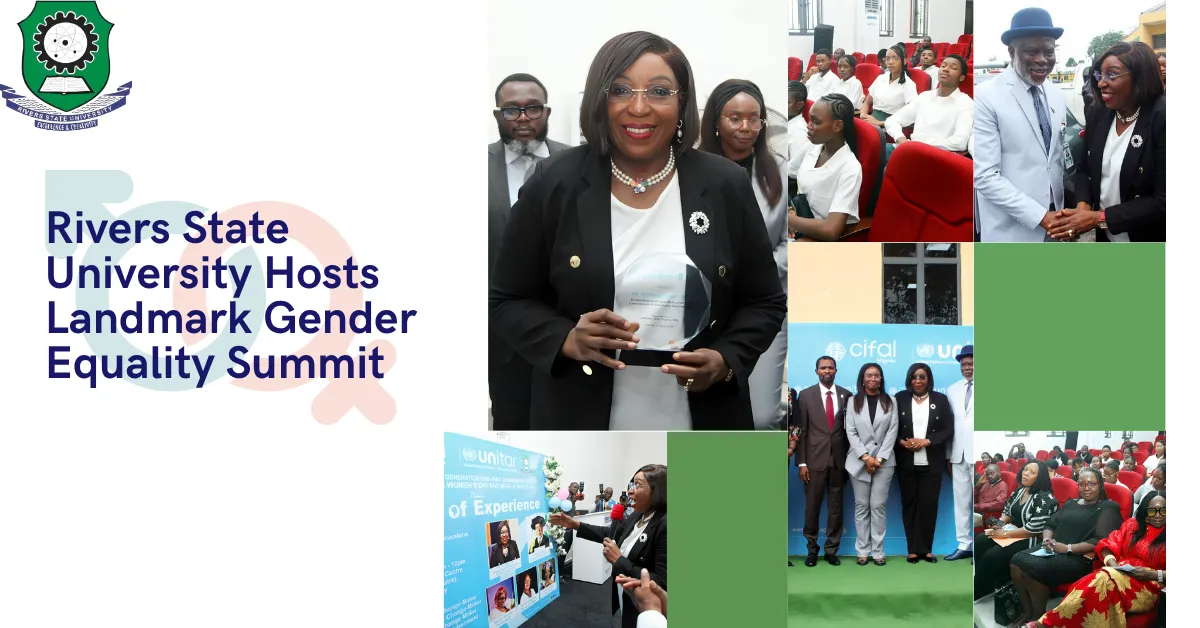
A high level gathering at Rivers State University has placed the Institution at the centre of a National conversation on gender equality, inclusive leadership and sustainable development, as academics, government officials, and Civil Society Leaders united to demand stronger mentorship structures for Nigerian women.
The event, held on 24 March 2026 at the university complex, was organised by the CIFAL Global Network through its Nigerian arm in Port Harcourt, forming part of a joint commemoration of International Women's Day and World Water Day. It drew stakeholders from government, academia and civil society into a unified dialogue on inclusive progress.
The Deputy Governor of Rivers State, Ngozi Nma Odu, delivered a compelling address in which she described mentorship as a critical driver of empowerment, arguing that structured guidance equips younger generations with the confidence and tools needed to challenge inequality and shape inclusive societies. She praised the Women's Elders Forum as a transformative platform for dialogue, advocacy and intergenerational knowledge transfer. "You can observe that all three sectors are gathered here today, highlighting the importance of cross sector collaboration in achieving long term development goals. Partnerships like these strengthen governance frameworks and create sustainable pathways for change," she said.
The Vice Chancellor of Rivers State University, Professor Isaac Zeb Obipi, stressed that the dual celebration amplified the voices of Nigerian women while spotlighting their essential role in water resource management. He noted that women remain at the forefront of water conservation and governance, making their inclusion indispensable to ensuring equitable access to clean water.
Keynote speaker Ibim Semenitari, addressing the gathering on the theme "Inclusive Leadership: Building Institutions that Reflect All Voices," framed mentorship as the very foundation of inclusive leadership, describing it not merely as guidance but as a vehicle for access, exposure and the transfer of influence. "Where mentorship flows, leadership grows. Where mentorship is blocked, inequality deepens," she declared, calling for a shift away from traditional hierarchical mentoring systems towards more collaborative and structured engagements that reflect the realities of today's youth.
Ihuoma Njemanze shed light on the broader scope of the CIFAL initiative, established in 2003 and coordinated by the United Nations Institute for Training and Research. She explained that the Port Harcourt centre was founded to support training and multi stakeholder cooperation aligned with the United Nations Sustainable Development Goals.
The event concluded with a collective call to action, urging stakeholders to amplify marginalised voices, invest in mentorship frameworks and build institutions that reflect true diversity and inclusion. For Rivers State University, the gathering reinforced its emerging role as a space where policy, scholarship and social justice converge, and where the next generation of women leaders are being equipped to drive change from within Nigeria's Institutions.
Leave a Reply