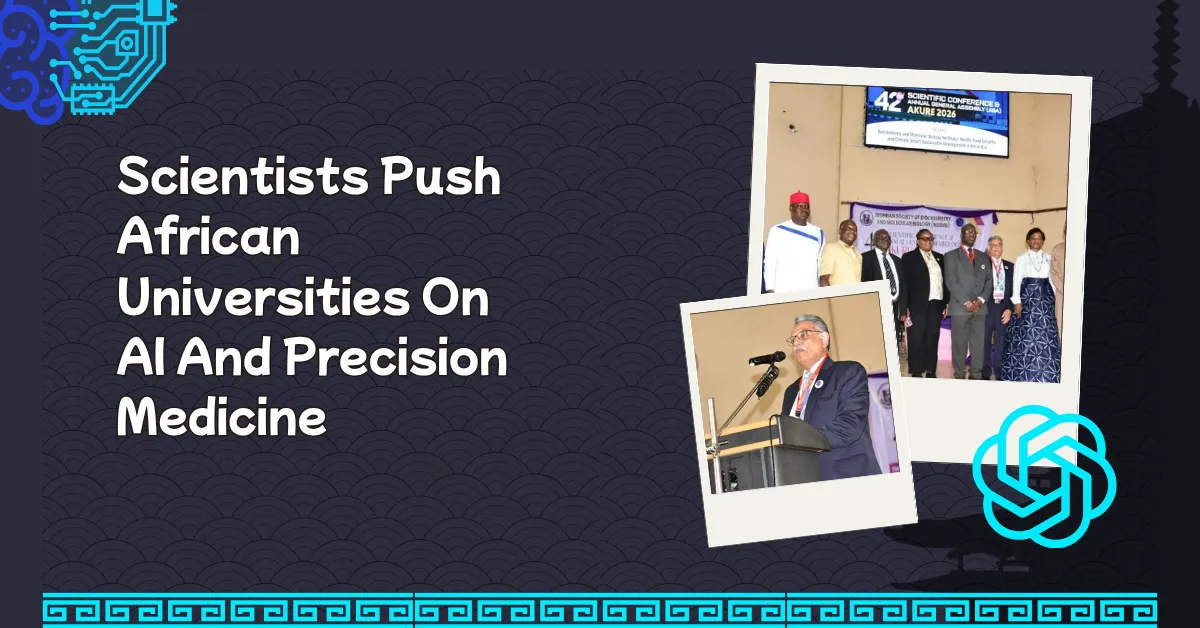
Leading scientists, researchers, and academics have called for greater investment in precision medicine, artificial intelligence driven research, and science education as critical pathways to transforming healthcare, food security, and sustainable development across Africa.
The position emerged at the 42nd Scientific Conference and Annual General Assembly of the Nigerian Society of Biochemistry and Molecular Biology, hosted by the Federal University of Technology, Akure, from July 6 to 10, 2026. Themed Biochemistry and Molecular Biology for Peace, Health, Food Security, and Climate Smart Sustainable Development in the AI Era, the conference brought together scholars, students, and scientists from Nigeria and several other countries to examine how emerging technologies can reshape education, research, and innovation on the continent.
Delivering the opening plenary lecture titled Personalised/Precision Medicine in Africa, Emeritus Professor of Medical Biochemistry and Structural Biology at the University of Cape Town and Secretary of the International Union of Biochemistry and Molecular Biology, Professor Mohamed Parker, described precision medicine as a revolutionary healthcare approach that uses an individual's genetic makeup, lifestyle and environmental factors to prevent, diagnose and treat diseases more accurately than conventional methods.
Parker noted that although Africa possesses the greatest human genetic diversity in the world, the continent contributes less than 2% of global human genome databases, a gap he said limits the development of treatments tailored to African populations. He called on governments, universities, research institutes, and private philanthropists to invest substantially in scientific research, laboratory infrastructure, and postgraduate training, expressing concern that Nigeria currently invests only about 0.30% of its Gross Domestic Product in research and development.
FUTA Vice Chancellor, Professor Adenike Oladiji, stated that universities must embrace interdisciplinary collaboration to address increasingly complex global challenges, explaining that combining Biochemistry, Molecular Biology, artificial intelligence, and computational science is already improving drug discovery, disease diagnosis, nutrition research and climate smart agriculture. She further challenged senior academics to mentor younger researchers to sustain research excellence.
President of the Nigerian Society of Biochemistry and Molecular Biology, Professor Matthew Wegwu, noted that Nigerian scientists continue to contribute significantly to vaccine research, biotechnology, metabolomics and environmental remediation, demonstrating the country's growing scientific capacity.
Representing the Ondo State Governor, Commissioner for Education, Science and Technology, Professor Igbekele Ajibefun, praised FUTA's growing reputation in research, innovation, and technology driven education, noting the University's contributions to national development.

Leave a Reply